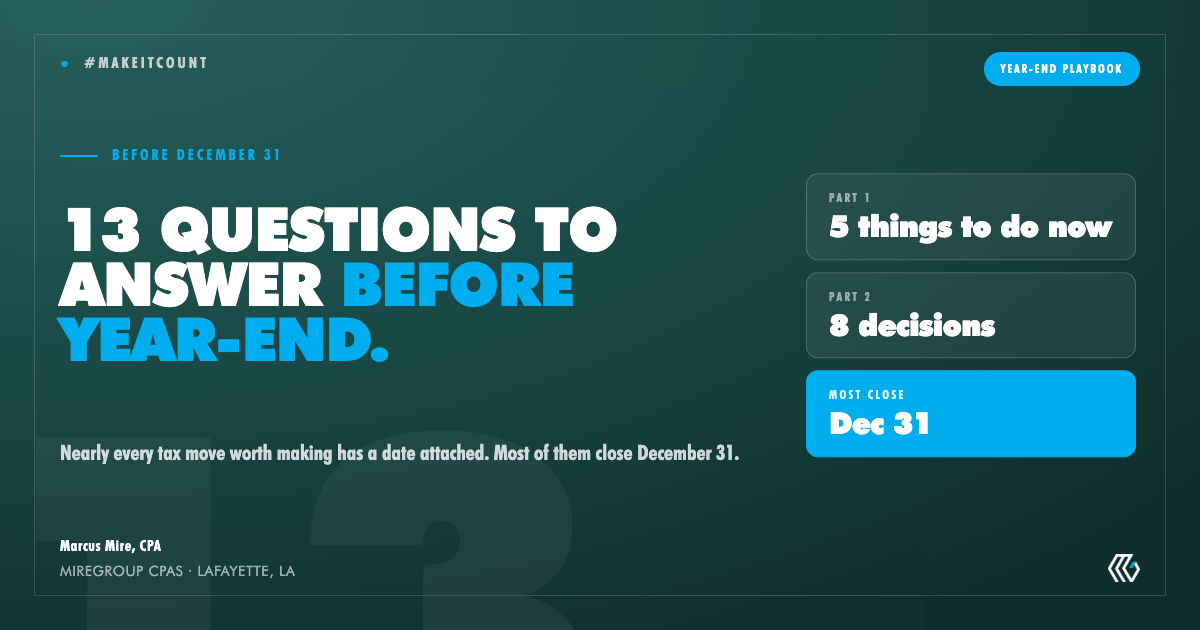
Almost every tax move worth making has a date attached to it, and most of those dates land before December 31. The useful tax conversation happens in the fall, while your books are current and somebody is looking at them.
So this issue is the whole year-end playbook in one place. The questions I get asked every fall, the decisions that have to get made, and when each one closes.
Save it. Forward it to your business partner. Work through it this month instead of the week after Christmas.
Want tips like these in your inbox? Sign up for our newsletter here.
Is This You?
- Your books are a few months behind. Maybe more.
- You couldn't tell me what the business has made this year if I asked right now.
- Somebody already told you to "go spend some money" before December.
- You set your S corp salary once and haven't looked at it since.
- Last April's bill was a surprise, and you aren't sure this one won't be.
If two or more of those landed, start at the top and work down. The order matters. Every decision in Part 2 runs on the answers from Part 1.
Part 1: Five Things to Do This Month
1. Are my books current enough to plan with?
Get them reconciled through September. This month.
And look, clean books means more than a reconciled bank account. You can categorize every transaction in the bank feed and still have books that are wrong. The whole balance sheet has to tie out: loan balances, credit cards, payroll liabilities, fixed assets.
The mistake I see all the time? You enter a bill. Then when you pay it, you code the payment straight to the expense instead of applying it to the bill. Now that expense is on your books twice. Your bank still reconciles perfectly. Your profit number is wrong, and every decision below gets built on top of it.
Read it here: What Clean Bookkeeping Looks Like
2. What is my profit going to be for the year?
Take your year-to-date numbers and project them out to December 31. Then answer one question. Is this a better year or a worse year than last?
That answer drives almost everything else in this email. A big year and a down year call for very different moves. And you can't compare this year to last year if this year hasn't been recorded yet.
Read it here: Why Can't Your CPA Do Tax Planning Without Good Bookkeeping?
3. Have I paid in enough tax?
The IRS runs a pay-as-you-go system. Your fourth quarter estimate is due January 15.
To stay clear of the underpayment penalty, pay in the lesser of 110% of last year's total tax or 90% of this year's. Last year's number is fixed. It's sitting on your prior return.
Here's the part most people miss. If you're having a big year, you can pay the safe harbor, park the difference somewhere it earns interest, and pay the balance when you file. Both routes avoid the penalty. One of them keeps your money working until April. That move only works with a real projection from #2.
Read it here: How to Pay Quarterly Taxes as a Business Owner
4. Is a K-1 coming with income I never took out?
If you own part of an S corp or a partnership, you pay tax on your share of the profit in the year the company earns it. Whatever you pulled out of the business is a separate event.
So if the company kept its profit in the bank this year to fund growth or build a cushion, a big number is still headed to your K-1. October is when somebody should be telling you that. Estimate it now and set the cash aside.
Read it here: Phantom Income Explained
5. How much cash should the business be holding?
Set a floor: 60 to 90 days of cash outflows. Start with monthly operating expenses from your P&L minus interest and cost of goods sold. Add average monthly inventory purchases if you sell products. Add your monthly loan principal payments, since those never show up on the P&L. Multiply by two or three.
Anything above that floor belongs in a high-yield savings or money market account. That's also a natural home for the tax money from #3.
Read it here: How Much Cash Should Your Business Keep in the Bank?
Part 2: The Decisions
Every one of these has a right answer for your business. None of them has a universal one.
6. Should I buy equipment or a vehicle before year-end?
Only if you needed it anyway.
Run the math. The write-off only gives you back a slice of what you spent. You still bought the thing.
So the purchase has to make the business stronger on its own. If you were already on the fence about a truck or a machine you need, the depreciation is a great sweetener, and timing it before December 31 is smart. Buying something just to shrink the tax bill is simply spending money.
Read it here: 2 Tax Planning Mistakes That Cost Small Business Owners
7. Is my S corp salary set right?
Two things pull on this number at the same time.
First, the IRS requires reasonable compensation, meaning what you would pay somebody else to do your job. Too low invites scrutiny. Too high and you're paying more payroll tax than you need to.
Second, above certain income levels your QBI deduction gets limited based on the W-2 wages the business pays. If you're the only employee or you have a small team, there's real planning in getting your salary into the right range.
This one is a calculation. It needs your actual numbers, and it has to happen before December 31.
Read it here: How to Pay Yourself as a Business Owner
8. I'm behind on salary and estimates. Is it too late?
Maybe not. This is one of my favorite year-end moves for S corp owners.
Run a year-end bonus through payroll to catch your salary up to reasonable compensation, and withhold a big chunk of it for federal and state income tax. Payroll withholding is treated as paid evenly throughout the year, no matter when it actually came out of the check. Withhold on December 31 and the IRS treats it like you paid on time every quarter.
Send that same amount as an estimated payment on December 31 and it only counts for the fourth quarter. Big difference.
Catch: you need to know where you stand before the last payroll of the year.
Read it here: The Complete Guide to Year-End Tax Planning for Small Business Owners
9. Want more in retirement? Raise my salary or use profit sharing?
For S corp owners, the obvious move is bumping your salary so you can max out your 401(k) employee deferral. That also means paying 15.3% in payroll tax on the extra wages.
There's often a better route. An employer profit-sharing contribution can get the same money into retirement without the extra payroll tax.
Employer contributions can generally be funded up until your filing deadline, extensions included. Make the decision with your CPA while the year is still open.
10. Should I be an S corp next year? Or stop being one?
There's no income level that makes an S corp automatically worth it, whatever threshold you've heard online.
The election saves payroll tax. It also shrinks your QBI deduction and adds a separate tax return, payroll, and payroll software. Sometimes the savings survive all that. Sometimes they don't.
I call the test return on hassle. Now is a good time to run the comparison on your own numbers.
Read it here: Does an S Corp Election Actually Save You Money?
11. Should I take this deduction now or push it into next year?
Sometimes the right plan is to pay more tax this year.
I recently talked with a client about doing exactly that, because what they were doing would save more tax in future years. A deduction is worth more in a year when you're in a much higher bracket.
So ask which year each deduction is worth the most in. Your projection from #2 answers it.
12. How should I give this year?
If you're charitable, the question is which dollars you give. Appreciated stock held more than a year in a taxable brokerage account gets you a deduction for the full market value, and the gain never gets taxed. I walked through it in September.
One more option worth a look. A donor-advised fund lets you bunch several years of giving into one year's deduction and send the money out over time.
Start now. Plenty of smaller nonprofits can't accept stock yet and need weeks to open a brokerage account.
Read it here: How Does Donating Appreciated Stock to Charity Work?
13. What should I set up for next year?
A budget. I know. Your grandmother told you to do it too.
Open Xero or QuickBooks Online in December and set a simple 2027 monthly budget. Compare it to actuals at the end of January. You can't manage what you don't measure, and next October's planning conversation gets a lot easier when the whole year was measured.
Read it here: Why Your Business Needs a Budget
Quick Answers to the December Questions
Will taking a distribution before year-end lower my bill?
No. A distribution comes out of profit the business already earned, and the tax already ran on it. Are Owner Distributions Tax Deductible?
Are bonuses taxed at a higher rate?
They get withheld at a higher rate. Your actual tax is calculated on total income for the year, and the return settles the difference. Are Bonuses Taxed at a Higher Rate?
What can wait until next year?
Very little. IRA and HSA contributions for 2026 can still be made up until April 15, 2027. Almost everything else on this list closes December 31. Two Tax Moves You Can Still Make
Pick the three questions above you can't answer today. Start there.
This is exactly what our advisory meetings are built for. We look back at where your business has been, map out where you want it to go, and build the plan to get there, while the year is still open (with good data!).
Read it here: What Happens in a MireGroup Advisory Meeting
That's why we run a fixed monthly fee, year round. If nobody is working through this list with you right now, we'd love to help. We walk through the whole thing here: www.mire.group/work-with-us
Make it count,
Marcus
P.S. If you take one thing from this issue, take this. Nearly every decision above closes on December 31, and none of them work without current books. Start with #1 this week.
#makeitcount

 Mire Group Marketing: Sep 30, 2026, 8:42:41 AM