Every year around November and December, small business owners start hearing the same advice: "You need to spend some money before year-end to save on taxes."
Maybe you've seen the car dealership commercials. Maybe your well-meaning friend suggested buying a new truck. Maybe even your CPA has told you to "go spend some money."
Here's the problem: spending $80,000 on a vehicle to save on taxes means you've still spent $80,000. You're only getting back 30-40 cents on the dollar in tax savings—and that's only if you have 100% business use.
That's not tax planning. That's just spending money.
Real tax planning is strategic. It's proactive. And it starts with a foundation most business owners skip: accurate, up-to-date bookkeeping.
In this guide, we'll walk through the year-end tax planning strategies we actually use with clients at MireGroup CPAs—and explain why none of them work without good data first.
Why Good Bookkeeping Is the Foundation of Tax Planning
You can't plan what you can't see.
If your books aren't up to date, you don't know what you've made. You can't project what year-end will look like. You don't know your current tax liability—and you definitely can't calculate the savings from any tax planning moves you might make.
You're flying blind.
Before diving into the trending strategies you see on social media, get your foundation right. Work with an accountant who can keep your books accurate and timely.
That's the approach we take with our accounting and tax plans. Then leverage that data for real tax savings.
As the IRS reminds taxpayers, the U.S. tax system operates on a pay-as-you-go basis. If you're not tracking your income and expenses throughout the year, you're setting yourself up for surprises come tax time.
What NOT to Do: The "Just Buy a Vehicle" Trap
Before we get into what works, let's talk about what doesn't.
In the video above, I break down why "just buy a vehicle" is lazy, sloppy tax planning. Here's the summary:
When someone tells you to spend $80,000 on a truck to save on taxes, remember:
- You've still spent $80,000
- You're only getting back 30-40 cents on the dollar
- That's assuming 100% business use (which is rare)
- The tax savings should be the sweetener to a deal you were already planning—not the reason for the purchase
If you were already planning to buy equipment or a vehicle for legitimate business purposes, then yes—timing that purchase strategically can make sense. But buying something you don't need just to reduce your tax bill? That's not a strategy. That's just spending money.
Now let's talk about what actually works.
Strategy #1: QBI Optimization
The Qualified Business Income (QBI) deduction allows owners of pass-through entities—think S-Corps, partnerships, and sole proprietorships—to deduct up to 20% of their qualified business income.
But here's what most people don't realize: once you hit certain income levels, the QBI deduction gets limited based on the W-2 wages you pay.
How It Works
For taxpayers above the income threshold ($182,100 for single filers, $364,200 for married filing jointly in 2023), the QBI deduction is limited to the greater of:
- 50% of W-2 wages paid by the business, OR
- 25% of W-2 wages plus 2.5% of the unadjusted basis of qualified property
If you're the only employee—or you have a small team—there's significant planning that can be done to get your salary in the right range to maximize QBI.
Year-End Action Items
- Review your year-to-date income projections
- Calculate whether adjusting your W-2 wages could increase your QBI deduction
- Work with your CPA to run the numbers before December 31st
This isn't something you can figure out in December without good data. It requires knowing your numbers throughout the year so you can make adjustments in real time. That's why we emphasize building a solid financial foundation with our clients first.
Strategy #2: Pass-Through Entity (PTE) Election
If you're in a state like Louisiana (or one of the 30+ other states offering this election), you may be able to elect at the company level to pay your state income taxes.
Why Does This Matter?
At the individual level, your state and local taxes (SALT) are limited to a $10,000 deduction thanks to the Tax Cuts and Jobs Act of 2017. But by making the PTE election and paying taxes at the entity level, you can work around this limitation.
Essentially, you're moving a deduction that wouldn't be fully deductible at the individual level to the corporate level, where it is fully deductible.
Year-End Action Items
- Determine if your state offers a PTE election
- Calculate the potential benefit based on your state tax liability
- Make the election before your state's deadline (varies by state)
- Ensure estimated payments are made at the entity level
Again, you can't know if this makes sense—or calculate the benefit—without accurate financial data. Flying blind isn't an option here.
Strategy #3: Strategic Retirement Contributions
Retirement contributions are one of the most powerful tax planning tools available. But how you structure those contributions can make a big difference in your overall tax picture.
The Payroll Tax Consideration
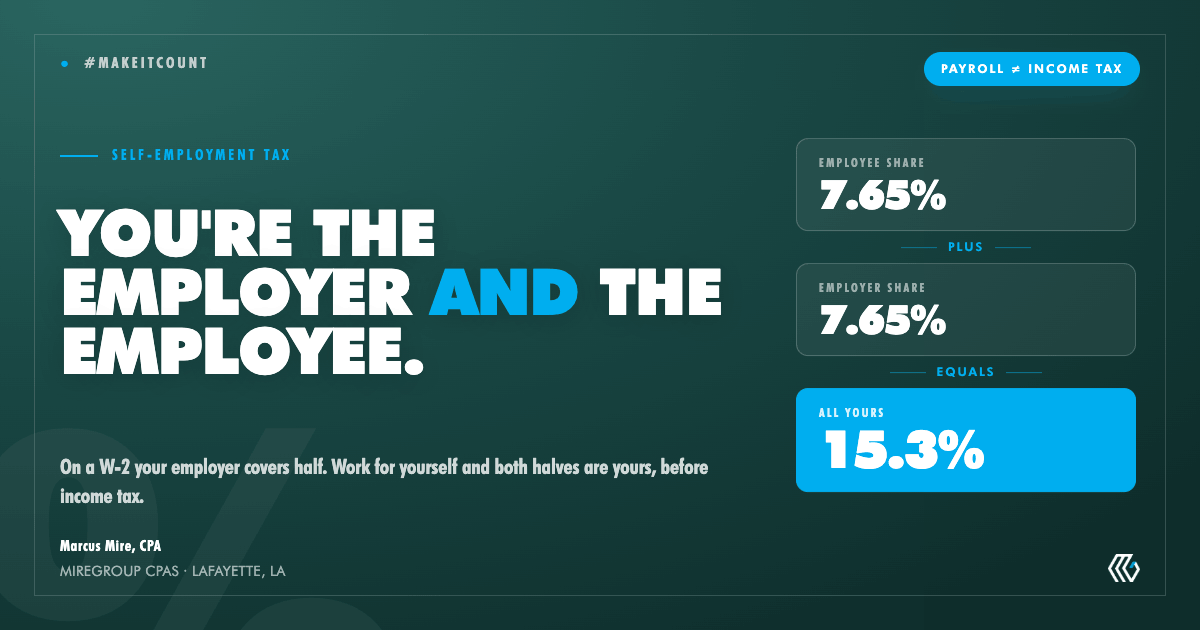
If you increase your salary to make larger employee contributions (like maxing out your 401(k) employee deferral), you're also increasing your payroll tax liability—15.3% for self-employment tax on the additional wages.
Here's a real example from a recent client engagement: They wanted to put more money into retirement. The obvious move might have been to increase their salary so they could make larger employee contributions.
But that would have meant paying an additional 15.3% in payroll taxes.
Instead, we structured it as an employer profit-sharing contribution. Same retirement savings. No additional payroll tax. The IRS allows employer contributions up to 25% of compensation (with overall limits), which can be a much more tax-efficient way to save.
Year-End Action Items
- Review your current retirement plan structure
- Calculate maximum employer contribution limits
- Determine if profit-sharing contributions make more sense than salary increases
- Fund employer contributions before your tax filing deadline (including extensions)
Strategy #4: Donating Appreciated Stock
If you own stocks that have significantly appreciated—think your NVIDIAs, Apples, or other winners sitting in a taxable brokerage account—you have a powerful tax planning opportunity.
In this quick tip, I walk through exactly how this strategy works. Here's the breakdown:
The Scenario
- You bought a stock for $20,000 (your cost basis)
- It's now worth $100,000
- That's an $80,000 unrealized capital gain
Option A: Sell and Donate Cash
If you sold the stock, you'd pay long-term capital gains tax on that $80,000 gain (typically 15-20% depending on your income). Then you'd have whatever's left to donate to charity.
Option B: Donate the Stock Directly
If you donate the stock directly to a qualified charity:
- You get a charitable deduction for the full $100,000 fair market value
- You completely avoid the capital gains tax on the $80,000 appreciation
- The charity receives the full $100,000
The charity receives more. You save more. Everyone wins.
Important: This only applies to stocks held in taxable brokerage accounts (think Schwab, Fidelity, TD Ameritrade)—not your 401(k), IRA, or other retirement accounts. Retirement account donations work differently.
The Bunching Strategy with Donor-Advised Funds
For those who are charitably inclined, donating appreciated stock can be combined with a donor-advised fund (DAF) for even more flexibility.
Here's how it works:
- Donate your appreciated stock to a DAF in a single year
- Take the full charitable deduction that year
- Distribute the funds to your favorite charities over multiple years
This "bunching" strategy allows you to exceed the standard deduction threshold in one year (maximizing your itemized deductions) while still spreading your charitable giving over time.
Bonus: State Tax Credit Programs
Some states offer tax credits for donations to specific organizations, like scholarship programs for schools.
In Louisiana, for example, you can donate to an organization that provides scholarships on a means-tested basis and receive a state tax credit of up to 95% of your donation. You can even direct the funds to a school of your choice.
Combine this with appreciated stock, and you've got a powerful triple benefit:
- Avoid capital gains taxes
- Get the federal charitable deduction
- Redirect your state tax dollars to a cause you care about
Year-End Action Items
- Review your taxable brokerage account for highly appreciated positions
- Identify qualified charities or consider opening a donor-advised fund
- Coordinate with your financial advisor and CPA before transferring shares
- Complete the transfer before December 31st for current-year deduction
Strategy #5: The S-Corp Year-End Bonus Hack
S-Corp owners are required to pay themselves "reasonable compensation." But sometimes, life gets busy and you fall behind on salary, or on quarterly estimated tax payments.
Before year-end, there's a move that can solve both problems at once.
[VIDEO EMBED PLACEHOLDER: Year-End S-Corp Bonus Hack] Embed: https://www.youtube.com/watch?v=trPtEMPaIBY
The Problem
Let's say your reasonable compensation as an S-Corp owner should be $75,000 for the year, but as of November, you've only paid yourself $25,000. You're also behind on quarterly estimated tax payments.
If you do nothing, you face two issues:
- Potential IRS scrutiny for inadequate compensation
- Underpayment penalties for not paying taxes quarterly
The Solution: Year-End Bonus with Heavy Withholding
Take a $50,000 bonus before December 31st to bring your total compensation to $75,000. But here's the key: withhold a significant portion for federal and state income taxes.
Why Withholding Is Treated Differently
Here's the magic: payroll withholding is deemed to be paid ratably throughout the year, regardless of when it's actually withheld.
That means if you withhold $40,000 on December 31st, the IRS treats it as if you paid $10,000 per quarter. Even if you hadn't made any estimated payments all year, you'd avoid underpayment penalties.
Compare this to making a $40,000 estimated tax payment on December 31st—that would only count as a Q4 payment, leaving you with penalties for Q1-Q3.
Year-End Action Items
- Calculate your reasonable compensation for the year
- Determine how much you've paid yourself to date
- Calculate your total tax liability and how much you've paid in
- Process a year-end bonus with appropriate withholding before December 31st
- Work with your payroll provider to ensure proper processing
This is a powerful hack, but it only works if you know where you stand before year-end. You need accurate books to make this calculation.
Year-End Tax Planning Checklist
Before December 31st, make sure you've addressed these items:
Financial Foundation
- [ ] Books are reconciled through November (at minimum)
- [ ] Year-end projections are complete
- [ ] Current tax liability is estimated
Income & Deductions
- [ ] QBI optimization analysis complete
- [ ] Pass-through entity election evaluated (if applicable)
- [ ] Retirement contribution strategy finalized
- [ ] Charitable giving plan executed (including appreciated stock donations)
S-Corp Specific
- [ ] Reasonable compensation requirement met
- [ ] Year-end bonus processed (if needed)
- [ ] Withholding covers tax liability
Documentation
- [ ] All receipts and records organized
- [ ] Mileage logs updated
- [ ] Home office calculations documented
The Bottom Line: Crawl Before You Walk
Here's what I tell every client: if you don't have your books up to date, and you're pitching your CPA on tax strategies you saw on social media, you're putting the cart before the horse.
Get an accurate set of books. Work with someone who can look at your data, make decisions, and project into the future. Then layer on the tax planning.
That's what most people want—to save money. But they try to skip straight to the exotic strategies without building the foundation first.
Don't default to buying a vehicle just because someone told you to "spend money." That's lazy, sloppy tax planning—and it's not economically sound.
Real tax planning starts with clarity. And clarity comes from good data.
Ready to Get Your Foundation Right?
At MireGroup CPAs, we help small business owners build a solid financial foundation—so they can make data-driven decisions and take advantage of real tax planning opportunities.
Our approach follows three phases:
- Record – Cloud-based bookkeeping that keeps your data organized and accessible
- Read – Regular reviews so you can make data-driven decisions
- Reap – Proactive tax planning that actually saves you money
If you're ready to stop flying blind and start planning strategically, let's talk.



 Mire Group Marketing: Aug 6, 2026, 11:21:10 AM