There is no income threshold that makes an S corp election automatically worth it. The election works by moving part of your profit out of self-employment tax, but a required reasonable salary, a smaller qualified business income deduction, a separate tax return, and payroll administration all take back a share of the benefit.
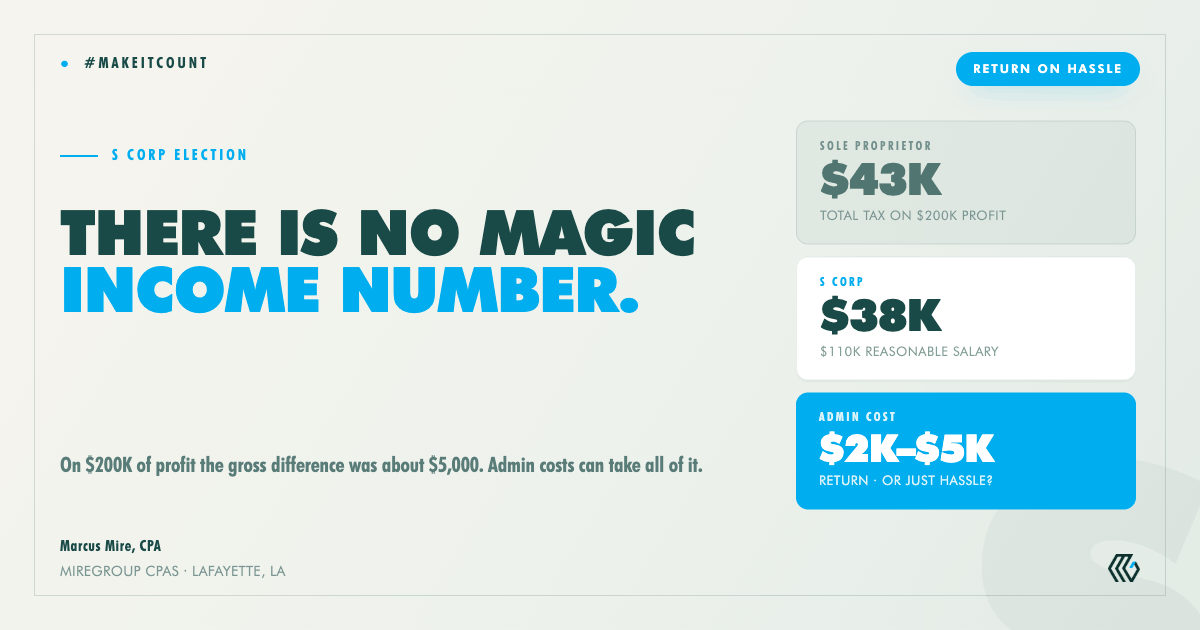
Marcus Mire, CPA, who leads MireGroup CPAs in Lafayette, Louisiana, walked through a live example on a business earning $200,000 of profit. The total tax difference came to roughly $5,000, and he is direct that administrative costs can wipe that out entirely.
The advice circulating online is that you should elect at $60,000 or $80,000 of profit. This example makes the case that the number is the wrong thing to be looking at.
Why does a single member LLC default to sole proprietorship?
When you own an LLC as the only member, the IRS defaults your tax treatment to sole proprietorship. You have to affirmatively elect to be taxed as an S corporation. Absent that election, you are a sole proprietor by default no matter what your LLC paperwork says.
That default is the starting point for the comparison below.
What does $200,000 of profit look like as a sole proprietorship?
As a sole proprietor you face two layers of tax. There is self-employment tax, which Marcus uses interchangeably with payroll tax, covering Social Security and Medicare. Social Security stops applying above an annual wage cap. Then there is income tax.
Self-employment tax applies to the bottom line, meaning net income after your deductible expenses. You do get to deduct half of it on your personal return, which reduces gross income.
The qualified business income deduction enters here. Marcus describes it as a 20 percent deduction for flow through entities that came in with the Trump tax cuts, applied to net business income less related items such as half the self-employment tax. Both sole proprietorships and S corporations are flow through entities, so both are eligible.
Running the full return in this scenario, assuming a married couple taking the standard deduction, produced about $15,000 of income tax and about $28,000 of self-employment tax. Total out of pocket was roughly $43,000. Marcus ran the figures through tax software to check them.
What is the S corp election actually trying to do?
Marcus calls this the crux of everything. The S corp election is an attempt to get out of payroll tax. The argument you are making is that not all of your income should arrive as self-employment income, and that you should receive a wage plus a distribution, with the distribution carrying no self-employment tax.
The IRS is aware of the incentive. That is why a reasonable salary is required, and why reasonable means reasonable for somebody who would do the job you are doing. As Marcus frames it, the salary requirement is the mechanism by which the IRS still collects payroll tax from S corp owners.
What happens to the same $200,000 as an S corp?
In this example the reasonable salary for the owner’s role is $110,000. You pay yourself that salary, and the company owes the employer share of payroll tax on it, which is deductible and runs roughly 8 percent.
After the salary and employer payroll tax, the S corp shows about $81,000 of profit. Because an S corp is a flow through entity, that profit lands on your personal return, alongside the $110,000 wage you already paid yourself. Total income of roughly $191,000.
Why does the QBI deduction shrink?
This is the piece Marcus flags as important and that most S corp content skips entirely.
The qualified business income deduction is based on the business’s income, and taking a salary reduces that number substantially. In the sole proprietorship scenario, QBI was calculated on roughly $185,000. In the S corp scenario, the company only earned about $81,000 after the salary, so QBI is calculated on that smaller base.
The deduction went from around $37,000 to around $16,000. That difference pushes taxable income up by about $26,000, costing close to $6,000 in additional income tax at a 22 percent marginal rate.
You are still in the same bracket as the sole proprietor. You are simply getting less of the flow through deduction because you converted business profit into wages.
What is the actual difference?
On the $110,000 salary, total payroll tax out of pocket runs about $18,000 across the employee and employer shares. The employer share is deductible at the company level. The employee share comes out of your paycheck, so it is still a cost to you.
Netting everything, the S corp scenario produced about $38,000 of total tax against about $43,000 as a sole proprietor. A difference of roughly $5,000 on $200,000 of profit.
Why might $5,000 of savings not be savings?
Because the S corp comes with obligations the sole proprietorship does not have.
You have to file a separate tax return for the S corp. You have to run payroll and pay for payroll software. Marcus estimates the administrative load at anywhere from $2,000 to $5,000 a year, which he notes can totally wipe out the savings.
At the top of that range, the $5,000 benefit is gone. At the bottom of it, you are keeping a few thousand dollars in exchange for a materially more rigid structure with more paperwork and more deadlines.
This is why the advice to elect at $60,000 or $80,000 does not survive contact with the numbers. If $200,000 of profit produces $5,000 of gross savings before admin costs, a business making a third of that has less room, not more.
What is return on hassle?
Marcus uses this phrase for the test that should sit underneath every tax strategy, and the S corp decision is his example of it.
You can end up in a situation where you have an S corp, you carry all the obligations, the structure is more rigid, there is more paperwork, and it has not done much for you. That is a hassle without a return.
His conclusion is that the S corp decision is genuinely nuanced and is not a hard and fast rule. Run the numbers for your own situation, or get a CPA to run them, before electing. The strategies that actually move the number are usually less exciting than the ones being marketed to you.
Frequently Asked Questions
Is there a profit level where an S corp always makes sense?
No. Marcus is explicit that it is not a hard and fast rule and not an if you make 50 grand or 60 grand decision. The right answer depends on your reasonable salary, your QBI position, and what administration will cost you.
What is a reasonable salary?
It is what someone would reasonably be paid to do the job you are doing in the business. The IRS requires it because the salary is where payroll tax gets collected in an S corp. Setting it artificially low is a known audit issue.
Why does my QBI deduction go down as an S corp?
The deduction is based on the business’s income, and paying yourself a salary reduces business income. In this example the QBI deduction dropped from roughly $37,000 to roughly $16,000 because the company only earned about $81,000 after the wage.
What does an S corp cost to maintain?
A separate tax return, payroll processing, and payroll software. Marcus puts the range at $2,000 to $5,000 a year in administrative costs, which is enough to erase the savings in many cases.
Can I undo an S corp election if it does not work out?
Revoking an election is possible but it is not a casual decision and it carries its own restrictions on re-electing later. That is a reason to run the numbers carefully before electing rather than treating it as reversible.
If you want someone to run this calculation against your actual numbers, see how we work.
Want this kind of breakdown in your inbox? Sign up for Make It Count.

 Mire Group Marketing: Aug 18, 2026, 8:24:42 AM