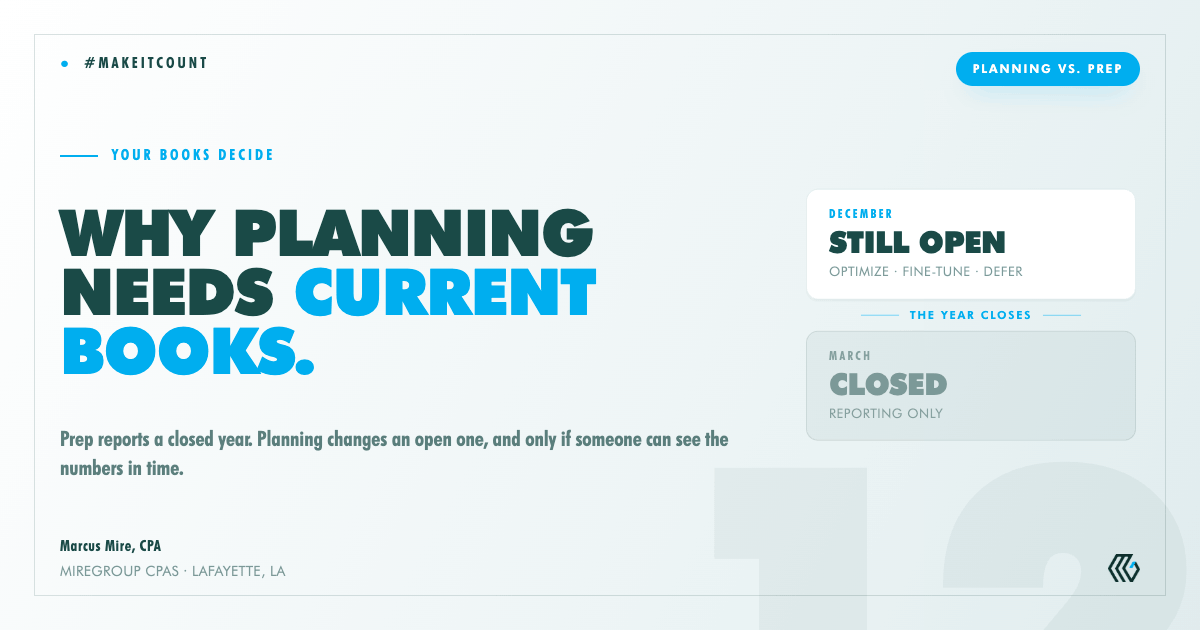
Tax planning depends on knowing what your business is earning while the year is still open. If your books are behind, incomplete, or unreliable, there is no current picture to plan against, and the only service left is preparation. Preparation reports what already happened. Planning changes what happens next, and it can only do that if someone can see the numbers in time to act on them.
Marcus Mire, CPA, who leads MireGroup CPAs in Lafayette, Louisiana, puts the dependency plainly: the way his firm does tax planning for small business owners is by leveraging their bookkeeping throughout the year to understand how they are doing, what money they are making, and whether this is a better year or a worse year than last.
Want this info straight to your inbox? Sign up for our newsletter here!
That sentence contains the whole constraint. Planning is not a smarter version of preparation. It runs on a different input.
What does tax preparation actually give you?
Almost everyone has to file a return, so someone has to prepare it. Plenty of owners hire a CPA once their situation gets more complex than they are comfortable with, and that is tax preparation.
Marcus describes preparation as looking in the rearview mirror. Once the year has ended there is not much you can do to change your tax situation. You are reporting what happened in the prior year in the most accurate and professional way possible. Done well, that has real value, and it is worth understanding how preparation and planning differ as services. It is just bounded. Your taxes, as he puts it, kind of are what they are.
That boundary is not a criticism of preparers. It is a description of when the work happens.
What does tax planning require that preparation does not?
Planning requires the year to still be open, and it requires visibility into the year while it is open.
At MireGroup that visibility comes from the bookkeeping. The firm is watching income through the year, comparing it against the prior year, and putting strategies in place well before year end. The point is to see the shape of the year early enough that decisions are still available.
If the books are six months behind, none of that is possible. You cannot compare this year to last year if this year has not been recorded. You cannot decide whether to accelerate or defer anything if you do not know where you are going to land. The strategies are not the hard part. The current data is.
What does your CPA do in December that he cannot do in March?
This is where the bookkeeping requirement stops being abstract.
Marcus notes that with the firm’s tax planning clients, they are doing things right up until year end, because the data is that good. They are optimizing and fine tuning in the last weeks of December. That is only possible when the books are current enough that the numbers in front of them reflect the business as it actually stands.
By March, those same conversations produce nothing. The year is closed. The same CPA, with the same expertise, is now limited to reporting. The difference between the two conversations is not effort or skill. It is whether the calendar and the books both allowed the conversation to happen in time.
Why would a CPA tell you to pay more tax this year?
One of the clearer signs that planning is a distinct discipline is that its answer is not always to minimize this year’s bill.
Marcus describes talking with someone about deliberately planning to pay taxes this year, because what they were doing would save more tax in future years. Part of planning is knowing when to take deductions and when to push them out, since a deduction can be worth more in a future year when you are in a much higher bracket.
That decision requires a view across years. Preparation, working one closed year at a time, has no vantage point for it.
What does "your foundation is set" actually mean?
Marcus uses the word foundation for the layer underneath all of this, and he is specific about what sits there: your bookkeeping, set up so it can be used to leverage real time data.
In practice that means transactions categorized consistently rather than cleaned up in a rush at year end, bank feeds reconciled on a regular cadence, and a chart of accounts that reflects how the business actually makes money. It also means you can read your P&L for cost structure rather than only for filing. It is unglamorous work, and it is the reason some owners get a December planning conversation and others get an April surprise.
Year round advisory sits on top of it. Entity structure decisions, questions answered through the year, optimization as conditions change. None of it functions without the layer beneath.
Why do most people want planning but only pay for preparation?
Marcus raises the gap directly. When people think about taxes, what they usually want is planning. What they are willing to pay for is preparation.
Part of that is visibility. A return is a deliverable you can hold. Planning produces an outcome you never see, which is the bill that did not arrive. Part of it is that planning is priced as the separate service it is, and it takes ongoing bookkeeping to support.
Marcus’s position on the economics is that done right, planning pays for itself. That is the claim worth testing against your own numbers rather than accepting on faith.
Frequently Asked Questions
Can I get tax planning if my books are behind?
You can get there, but the bookkeeping has to be caught up first. Planning conversations built on stale numbers produce guesses. Most firms, including MireGroup, will bring the books current before treating planning as a live service.
Is tax planning included with tax preparation?
Generally no. Marcus is direct that planning is a totally separate service and is something you would pay extra for. If planning is not named in what you are buying, you are almost certainly buying preparation.
When should tax planning conversations happen?
Throughout the year, with strategies in place well before year end. MireGroup works with planning clients right up until December 31 because the bookkeeping supports it, but the useful decisions are spread across the year rather than concentrated in the last week.
Does tax planning always mean paying less tax this year?
No. Sometimes the plan is to pay tax now because the deduction is worth more later, particularly if you expect to be in a higher bracket. Knowing when to take a deduction and when to push it out is part of the work.
What if I already have a CPA who only does my return?
That is the common situation, and it is not a problem in itself. The question worth asking is whether anyone is looking at your numbers before the year closes. If the answer is no, planning is not currently on the table regardless of who prepares the return.
MireGroup CPAs works with small business owners in Lafayette and across Louisiana on fixed fee bookkeeping, payroll, tax planning, and year round advisory. You can see how our plans are structured.

 Mire Group Marketing: Aug 18, 2026, 8:24:42 AM