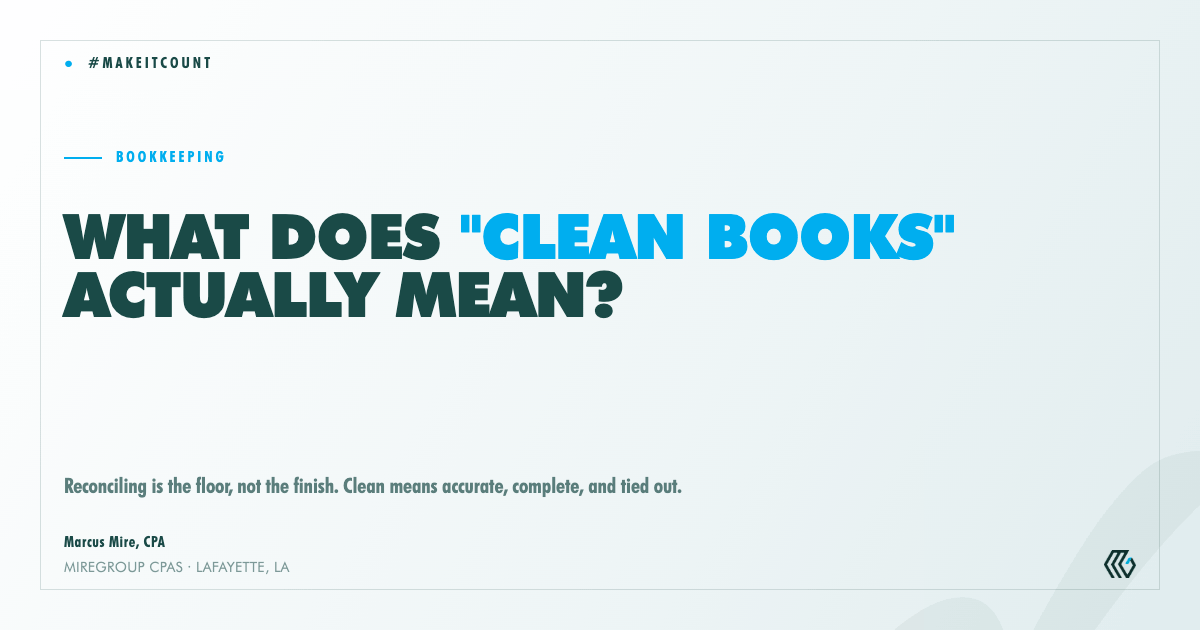
Clean books means your balance sheet is accurate, not just that your bank account reconciles. You can categorize every transaction in the bank feed and still have books that are wrong, because reconciling the bank tells you nothing about whether the rest of the balance sheet ties out. When the balance sheet is right, the way accounting works, your profit and loss statement comes out right too. Reconciling is one step. It is not the finish line.
Marcus Mire, CPA, founder of MireGroup CPAs in Lafayette, Louisiana, calls accounting the foundational piece of everything a small business does, from taxes to borrowing to operations. And he says clean books is the thing owners most often get wrong, usually because they have the wrong person in charge of the function. “Clean books does not mean you just reconcile the bank account,” he says. That one sentence undoes a belief a lot of business owners are proud of.
Isn’t reconciling the bank account the same as clean books?
No. Reconciling means you took the transactions that came in through the bank feed and categorized them so the recorded cash matches the bank. That is worth doing. But as Marcus puts it, “if you don't understand the output of that, i.e. the balance sheet, you can't be assured that you have clean books.” The reconciliation confirms one account. It says nothing about whether the rest of your books are accurate.
He hears the confusion constantly. “They always tell me, hey, I reconciled the bank account,” he says, “but they don't know how to handle accounts payable, how to handle accounts receivable.” Those are exactly the areas where a set of books goes wrong while the bank still looks perfect.
What does an accurate balance sheet actually mean?
It means everything on the balance sheet is tied out and reconciled as of a specific date, not just the bank. In Marcus’s words, that is your “fixed assets, your loan balances, your credit cards, your payroll liabilities,” all reconciled as of a certain date, with no negative amounts sitting where positives should be or the reverse. When that is true, the balance sheet is right, and because of how double-entry accounting works, the P&L nets out correctly too.
That does not mean every account is perfectly placed. You might have an expense sitting in “office” that really belongs in “computer expense.” But the fundamentals, the income and expenses netting to the right bottom line, are accurate. Getting the balance sheet right is what makes the rest trustworthy.
How do books get quietly wrecked even when the bank reconciles?
Here is the most concrete example in the whole talk, and it is the one Marcus says he sees all the time. You put a bill into your system, which records the expense. Then you go to pay that bill, but instead of applying the payment against the bill you already entered, you “just put that right to the expense account.” Now the same expense is on your books twice, and your accounts payable are wrong. “I see that happen all the time when people say they are reconciling.”
The reason this is so dangerous is that the bank account still reconciles perfectly. The cash left your account exactly once, so the reconciliation is clean. The error lives in how the transaction was recorded, not in whether the cash matches, which is precisely why reconciling cannot catch it. If the only thing you check is the bank, this mistake is invisible, and it repeats every month it goes unnoticed.
Why does getting this right matter?
Because clean books are the jumping-off point for everything else. As Marcus frames it, “if you don't have your balance sheet right, you don't have the foundation.” Get it right, and the next question becomes how timely and accurate that information is, so you can actually use it to make management decisions, plan for taxes, and build a budget you can trust. You cannot get strategic advice on bad data, and you cannot plan around a profit number that is overstated because an expense got booked twice. The foundation has to be solid before anything you build on it means anything.
Want more like this? Make It Count is our newsletter for owners who’d rather build a solid foundation than chase hacks. Subscribe and get our free guide, You Don’t Need a Loophole. You Need These 7 Principles: mire.group/newsletter-signup
Not sure your balance sheet actually ties out? We’d love to take a look and tell you straight: mire.group/work-with-us.
Frequently Asked Questions
Does reconciling my bank account mean my books are correct?
No. Reconciling only proves your recorded cash matches the bank. It does not confirm that accounts payable, receivable, and the rest of the balance sheet are accurate. Clean books require the whole balance sheet to tie out.
What makes a balance sheet accurate?
Every account is tied out and reconciled as of a specific date: fixed assets, loan balances, credit cards, and payroll liabilities, with no balances sitting negative when they should be positive. When the balance sheet is right, the P&L nets out right too.
How do books get double counted?
A common way is entering a bill and then coding its payment straight to the expense account instead of applying it to the bill. The expense lands twice and payables are overstated, even though the bank still reconciles perfectly.
Why does the balance sheet matter more than the P&L?
Because that is where hidden errors live. Owners tend to watch the P&L, but if the balance sheet is wrong, the P&L usually is too. Get the balance sheet right and the rest falls into line.
Who should be handling this?
Someone who understands the full balance sheet, not just the bank feed. A lot of clean-books problems trace back to having the wrong person in charge of the function, which is why the mistakes go uncaught.

 Mire Group Marketing: Oct 8, 2026, 12:08:35 PM