If you own a flow-through business, the business itself usually does not pay income tax. The profit flows to you and you pay tax on it personally, whether or not you ever moved the money to your own account. That single fact drives almost everything else: why your tax bill does not match what you took home, why distributions do not reduce what you owe, and why so many owners get blindsided in April.
I'm Marcus Mire, CPA and founder of MireGroup CPAs in Lafayette, Louisiana. This is the guide I wish every new client had read before their first meeting with us. It covers how your entity is taxed, how you actually get paid, what a distribution is, what self-employment tax does to you, and where the surprise bill comes from. Each section links out to the full breakdown if you want to go deeper.
What kind of entity do you have, and why does it matter?
Start here, because everything downstream depends on it.
An LLC is a legal structure. It is registered with the state and it exists to protect you. It says nothing about how you are taxed.
The tax treatment gets elected separately. Your LLC can be taxed as a sole proprietorship, a partnership, an S corporation, or a C corporation. Two businesses with identical LLC paperwork can have completely different tax outcomes depending on what was elected.
Sole proprietorship, partnership, and S corp are all flow-through entities. We also say pass-through. Same thing. The business calculates its profit and passes it to the owners, who report it on their personal returns.
We walk through what each election actually means in LLC Taxes Explained.
How do you actually pay yourself?
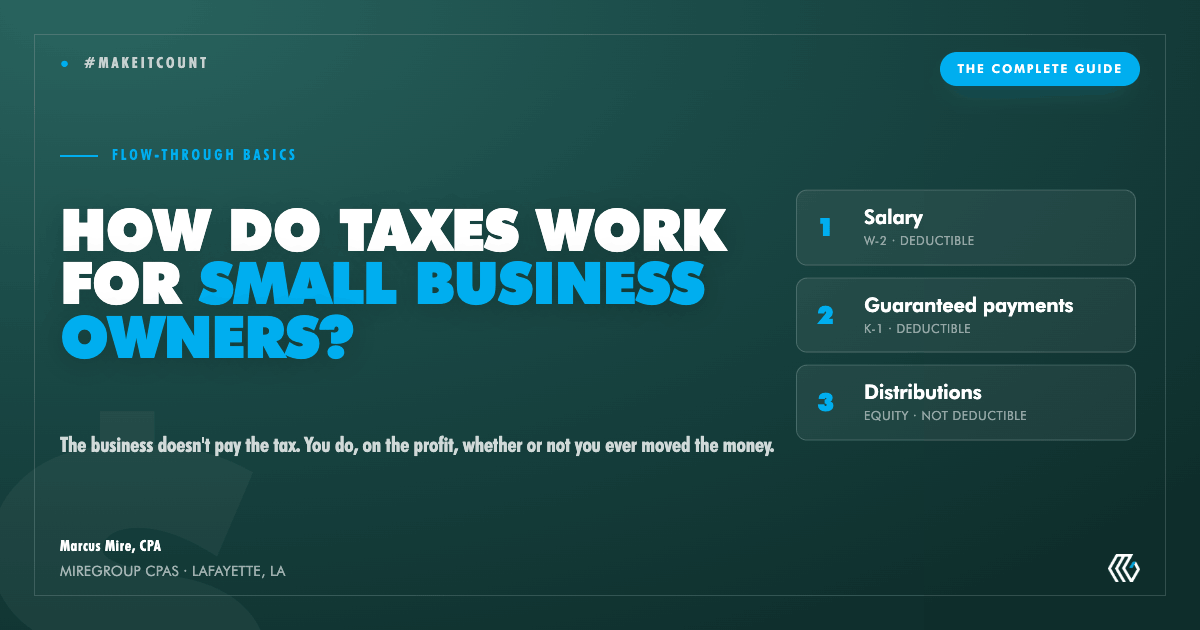
There are three ways money moves from your business to you, and they are taxed differently.
Salary. You run payroll, you get a W-2, taxes are withheld. The business deducts it. This is what S corp owners do.
Guaranteed payments. Partnerships use these. They show up on your K-1. The partnership deducts them.
Distributions. You move profit out of the business to yourself. No payroll, no withholding, no deduction.
Which of these is available to you depends entirely on your entity. A sole proprietor cannot put themselves on payroll. An S corp owner who takes only distributions and no salary has a problem waiting for them.
Full breakdown in How to Pay Yourself as a Business Owner.
What is a distribution?
A distribution is profit leaving the business and landing with you.
The money was already earned by the business. It was already reported. Already allocated to you on a K-1 or a Schedule C. Moving it to your personal account does not create a second event.
The mirror image works the same way. When you put your own money into the business as a capital contribution, that is not income to the business. Nobody expects it to be. Money in is not income. Money out is not an expense.
LLC Distributions Explained covers the mechanics on both sides.
Are owner distributions tax deductible?
No. This is the single most common question I get, and the answer trips up a lot of people.
A distribution comes out of profit. Profit sits in equity. Equity does not produce a deduction.
Think about what a deduction does. It reduces the income the business reports. A distribution happens after that income is already calculated. The profit exists first, and then you take some of it out. There is nothing left to reduce.
What you can deduct is salary reported on a W-2 and guaranteed payments reported on a K-1. Both of those are compensation for work performed. Both are deductible to the business and taxable to you. A distribution is a different animal.
So taking a large distribution in December does nothing to your tax bill. If you are sitting down to estimate what you owe and you are treating distributions as a lever, the number is going to come out wrong.
Where distributions belong in your books
On the balance sheet. If your distributions are showing up on your profit and loss statement, somebody is trying to make the P&L do the job of a cash flow statement. Those are two different reports doing two different jobs.
A debt paydown falls in the same category. Cash left the account and no expense was created. Principal reduction is a balance sheet transaction.
When distributions sit on the P&L, your reported profit looks lower than it is. Then you plan around a number that was never real, and the tax bill shows up anyway.
One caveat worth knowing. A distribution that exceeds your basis in the business can become taxable. That is a narrower situation and it depends on your specific numbers, so walk it through with your CPA rather than assuming.
Why do you owe tax on money you never took?
Because the tax follows the profit, not the withdrawal.
Your business earns $200,000. You leave $150,000 in the account to cover payroll and inventory and take $50,000 out. You are taxed on the full $200,000, because that is your share of what the business earned.
That gap is what people mean by phantom income. Income allocated to you for tax purposes with no cash attached to it. It shows up constantly in partnerships and in growing businesses that are reinvesting.
More on it in Phantom Income Explained.
What is self-employment tax and why is it so big?
Self-employment tax is the payroll tax. Social Security and Medicare.
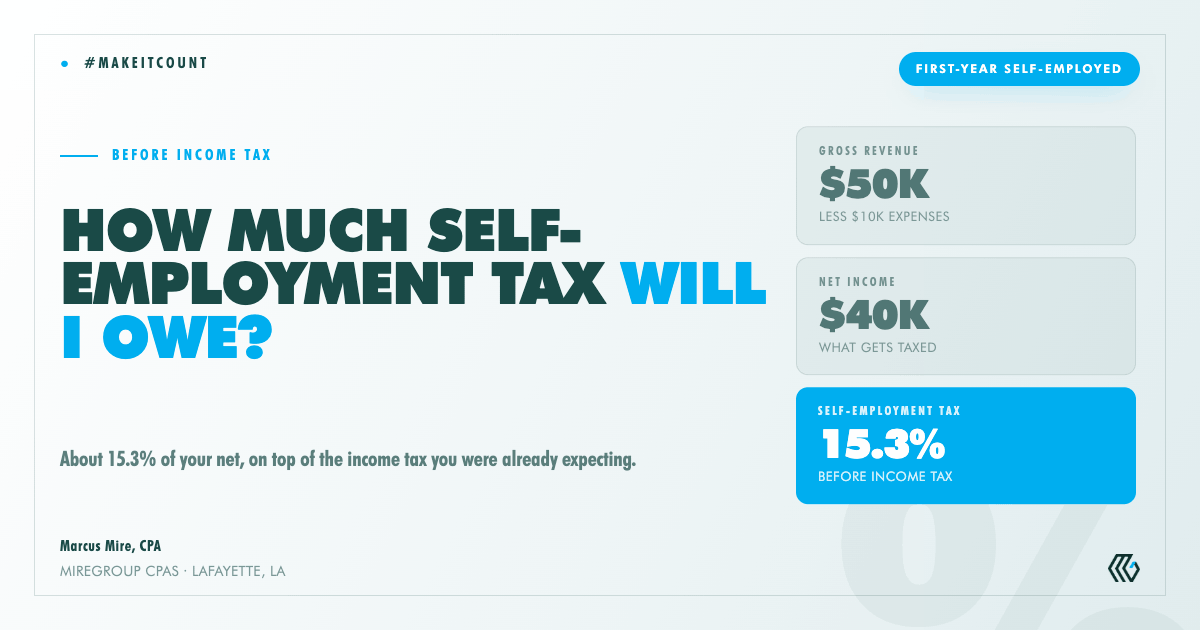
Pull up a pay stub from a regular job and you will see those two lines coming out at a combined 7.65%. What most people never notice is that the employer is matching it, paying another 7.65%. Together that is 15.3%, split between the two parties.
When you are self-employed, you are both parties. You pay both sides.
That is roughly 15% off the top of your net income before you get anywhere near income tax. It feels different because nobody is withholding it for you. Nothing is coming out along the way, so there is no signal that it is piling up.
This is the one that catches consultants, gig workers, and anybody with a side business. It applies to income that comes to you directly. Income you take through an S corp works differently, which is the whole reason people look at that election.
The mechanics are in How Does Self-Employment Tax Work?
Does an S corp election save you money?
Sometimes. There is no income threshold that makes it automatically worth it, no matter what you have read.
The election works by splitting your profit into two pieces. You pay yourself a reasonable salary, which runs through payroll and carries payroll tax. The rest comes out as a distribution, which does not carry self-employment tax. That gap is where the savings live.
What people skip is the cost side. Payroll processing, a separate business return, more bookkeeping, and a defensible answer for how you landed on that salary number. Those costs are real and they do not scale down for a small business.
So the calculation is the savings against the cost, on your actual numbers. We run it in Does an S Corp Election Actually Save You Money?
Why does the bill surprise you every April?
Because nobody in the arrangement has the job of warning you.
A lot of owners work with a tax preparer. I am not knocking that. Look at what the service is, though. You hand over documents after the year has closed and you get back a return. There is no place in that engagement for anybody to tell you a bill is coming, because by the time anyone is looking at your numbers the year is over.
The surprise is structural. People are not getting bad service. They bought a different service than the one they needed.
What you want is somebody collecting information from you during the year, running the calculation, and telling you the number before it arrives. That is the whole point of regular advisory meetings.
At MireGroup we really don't work with people who won't let us do advisory for them. We run calculations quarterly and tell clients what they should be paying in. They may not pay it, and that's their call. But they are not surprised in April, because we told them about it in June.
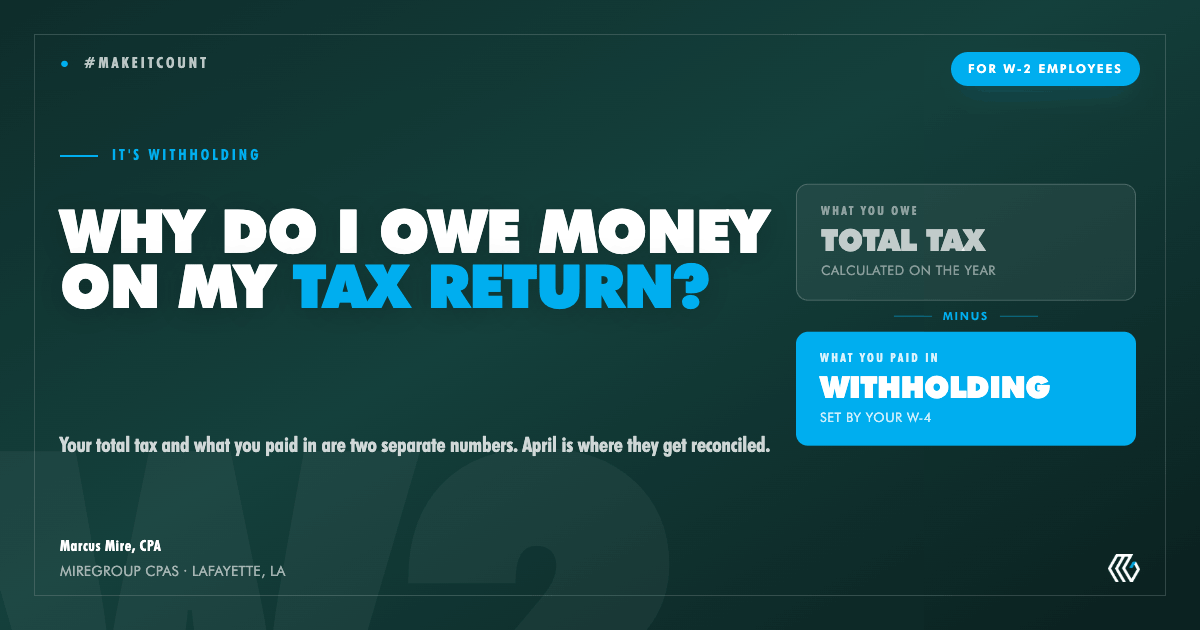
If you want the full walkthrough of where the surprise actually comes from, we covered it in Why Do I Owe Money on My Tax Return?
Where does all of this start?
Your books.
Every calculation on this page runs on your numbers. What your profit actually is. What your basis is. Whether your distributions are sitting in the right place. If the books are behind or wrong, none of it can be answered, and the planning conversation cannot happen at all.
That is why we start there with every client. Foundation first, strategy throughout, tax at the end. More on why that order matters in Why Can't Your CPA Do Tax Planning Without Good Bookkeeping?
Frequently asked questions
Do I pay tax on a distribution?
Generally you are taxed on your share of the business's income, not on the act of taking the distribution. You pay tax when the business makes the money, not when you move it. Basis limits and prior year losses can change that, so it is worth walking through your specific situation.
Are S corp distributions tax deductible?
No. S corp distributions come out of accumulated profit and get recorded as equity transactions. The deductible piece is the salary you run through payroll.
Should distributions show up on my profit and loss statement?
No. They belong on the balance sheet. If they are on your P&L, your reported profit is understated and any tax estimate built on it is going to be off.
How much should I set aside for taxes?
For side income and consulting work, about 30% is a reasonable rule of thumb. Fifteen for self-employment tax and fifteen for income tax. If other income is pushing you into a higher bracket, closer to 40%. It is a rule of thumb, so it will not be exact, and it beats getting to April with nothing reserved.
Is a loan payment deductible?
The interest portion is. The principal portion is not. Paying down principal is a balance sheet transaction, the same as a distribution.
If you are trying to figure out where your money is going and what you are actually going to owe on it, we'd love to help.

 Mire Group Marketing: Sep 23, 2026, 10:18:21 AM