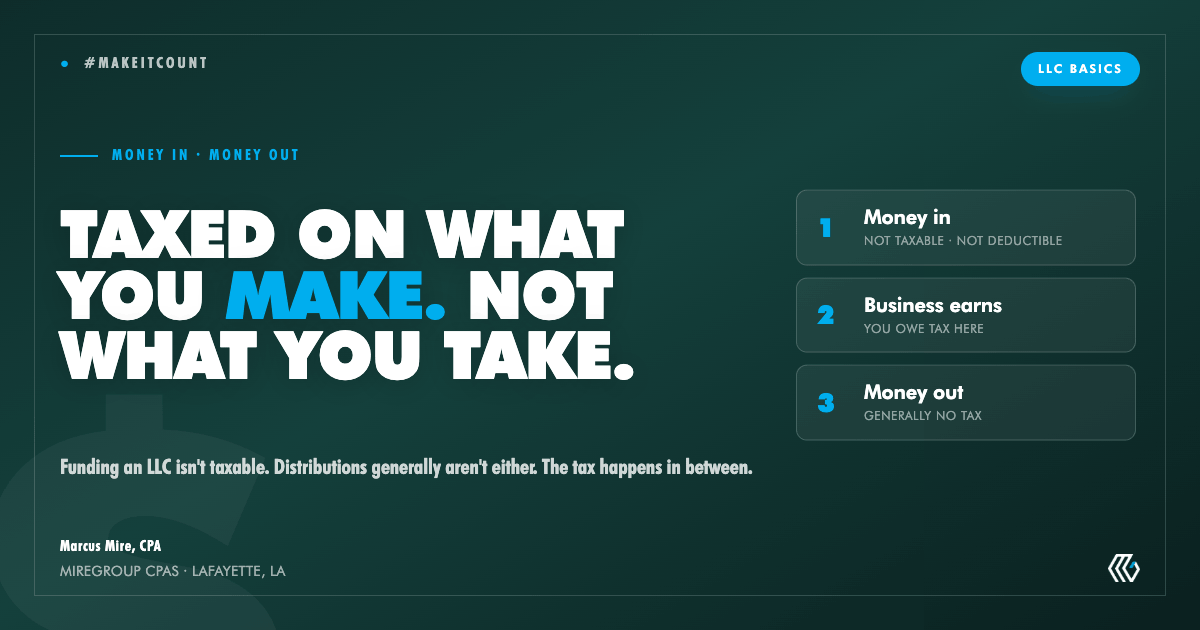
Contributing your own money to an LLC is not taxable income to the business and not a deduction for you. Taking profit distributions out later is generally not a taxable event either. The tax happens in between, when the business earns money, and it happens whether or not you move that money to your personal account.
Want helpful accounting tips in your inbox? Get our newsletter here!
Marcus Mire, CPA, who leads MireGroup CPAs in Lafayette, Louisiana, recorded this after a new client meeting where most of the questions were about exactly this. How do you fund an LLC, and how do you take money out. The mechanics are simpler than owners expect. The timing is what causes the trouble.
Is there such a thing as an LLC tax return?
No. Marcus starts here because the rest only makes sense once this is clear. A limited liability company is a state law entity, and the tax code has no LLC return. LLCs have default tax treatments instead.
An LLC with one member is by default a sole proprietorship, a disregarded entity. If you have ever done consulting, gig work, or freelancing, you were a sole proprietor, and Marcus is direct that a single member LLC without an S corp election is no different. That default is also why self-employment tax applies to your full net profit in that structure.
An LLC with multiple members is by default taxed as a partnership. It can elect to be taxed as a corporation instead, either an S corporation or a C corporation. Partnerships and S corporations are both flow through entities, which is the category that drives everything below.
What happens when you fund your LLC?
Nothing, from a tax standpoint. When you contribute money to an LLC taxed as a sole proprietorship, partnership, or S corporation, there is no tax effect. The money is not taxable to the entity, and you do not get a deduction for putting it in.
That holds whether you contribute at formation or later. Moving cash from your personal checking account into the business account is not a transaction the tax code treats as income or expense.
Where does funding get complicated?
The contribution itself stays simple. How you got the money may not.
If the funds are idle cash sitting in your checking account, Marcus says nothing has happened. But if you have to liquidate a stock position, sell crypto, or sell an asset to raise the money, you determine gain or loss on that sale and pay tax on it personally. Then you take the proceeds and fund the LLC.
The LLC did not cause that tax. The sale did. Owners sometimes conflate the two and assume funding a business triggered a bill, when the trigger was the liquidation that came before it.
Borrowing is different again. If you borrow money personally and put it into the LLC, Marcus notes that nothing has really happened there either.
Why do you owe tax on money you left in the business?
This is the part that trips up the most owners, and Marcus states it in one line: you pay taxes on the money you make, not the money you take.
Consider a flow through entity that makes $100,000 in a year, with that $100,000 sitting in the business bank account on December 31. You pay tax on the $100,000 for that year, whether or not you moved any of it into your personal checking account.
Owners push back on this constantly. They say they have not taken anything out. Marcus’s answer is that the tax code does not care. Owners, shareholders, and partners of a pass through entity pay tax on their share of the entity’s earnings whether the money has been distributed or not.
This matters most for owners deliberately leaving profit in the business to fund growth. The cash stayed put. The tax bill did not, which is one reason deciding how much cash to hold has a tax dimension as well as an operating one.
What happens when you finally take the money out?
Usually nothing, and this is where the logic closes.
Marcus follows the same $100,000 example forward. The partnership earned it in 2026, and all the partners paid tax on their share for 2026. On January 1, 2027, the partners decide to wind things down and distribute the entire balance. Each owner takes a pro rata share of the $100,000.
At that point there is zero tax. The distribution is not taxable income, because the income was already taxed in the prior year when it was earned.
Seen from the outside, an owner moved $100,000 into a personal account and owed nothing. That looks like a loophole to people who missed the year before. It is simply the second half of a rule whose first half already ran.
What are the caveats?
Marcus is careful to flag that he is giving high level concepts, and that the general rules above come with real exceptions.
Debt changes things. Basis limitations can change whether a distribution is tax free. S corporations in particular have their own rules around distributions that do not track the partnership treatment exactly, which is one of several reasons the S corp election is worth running the numbers on before you make it. This discussion also sets aside salary payments in an S corp and guaranteed payments in a partnership, which are separate categories from profit distributions.
The framework holds for most owners in most years. It is worth confirming against your own facts before relying on it for a large distribution.
Frequently Asked Questions
Do I owe tax if I leave all the profit in the business?
Yes. In a pass through entity you pay tax on your share of what the business earned, regardless of whether the money was distributed. Marcus puts it as paying tax on the money you make, not the money you take.
Is a distribution the same as a paycheck?
No. Profit distributions are a different category from salary in an S corp or guaranteed payments in a partnership. Those are paid and taxed differently, and this framework does not cover them.
Can I take money out of my LLC whenever I want?
Mechanically, distributions are flexible in most single owner situations, and generally are not a taxable event on their own. The practical limits are cash flow, any agreement among multiple owners, and basis rules, which can change the answer in specific cases.
Does putting my own money into the business give me a deduction?
No. Contributing capital is not deductible to you and not income to the business. It is simply a transfer between you and an entity you own.
What if I sold stock to start my business?
You will have a gain or loss on that sale to report personally, and you pay tax on it before the money ever reaches the LLC. The contribution to the LLC remains a non event. The sale is the taxable piece.
If you are unsure how your entity is taxed or how to take money out of it cleanly, MireGroup CPAs can walk through it with you. Work with us.


 Mire Group Marketing: Aug 18, 2026, 8:24:42 AM