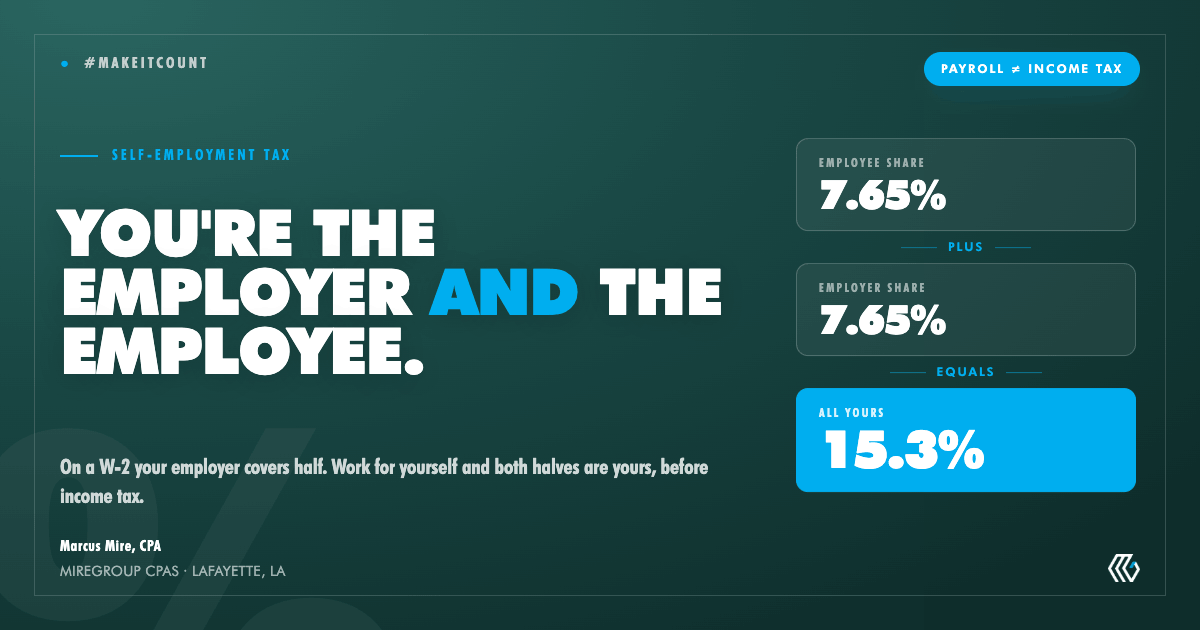
Self-employment tax is the same Social Security and Medicare tax that comes out of a W-2 paycheck. As an employee you pay 7.65% and your employer matches it, for a combined 15.3%. When you work for yourself, you are both the employer and the employee, so you pay roughly 15.3% on your net business income. That is separate from income tax and comes before it.
Marcus Mire, CPA, who leads MireGroup CPAs in Lafayette, Louisiana, says this is one of the most common questions he gets and one of the things people most often misunderstand. His approach is to build it out of something almost everyone has already experienced.
What actually comes out of a W-2 paycheck?
Nearly everyone has worked for somebody at some point. On a W-2, Social Security and Medicare are withheld by law: 6.2% for Social Security and 1.45% for Medicare, for 7.65% total.
The part employees rarely see is that the employer matches those same amounts. Another 7.65% is being paid on your wages that never appears on your pay stub. Between the two sides, 15.3% is going in as payroll tax.
Marcus is careful to separate this from income tax. Payroll tax has nothing to do with your tax return or your income tax bracket. It is its own layer.
What changes when you work for yourself?
The employer disappears, and you inherit its share.
When you are self-employed and have not made an S corp election, you are both the employer and the employee. Both halves of that 15.3% are yours. Marcus’s example: you are a consultant operating as an LLC with no S corp election, and after all your deductible expenses you have $100,000 of net income. Before you pay any income tax at all, you owe self-employment tax on that $100,000, at roughly 15.3%.
He uses roughly deliberately. There are caveats in the exact calculation, including a Social Security wage cap and a deduction for half the tax on your personal return. The order of operations is the part worth holding onto: the payroll layer applies to net business income first, and income tax comes after.
Which business owners pay self-employment tax?
Marcus names the common cases directly.
If you are a sole proprietor with net taxable income, you have this tax. That includes a single member LLC that has not elected S corp status, since the IRS defaults it to sole proprietorship treatment. It also includes side hustles and unincorporated activity. We walk through the default tax treatment of an LLC in more detail separately.
If you own an LLC taxed as a partnership and you work in the business, your share of net income is self-employment income and carries this tax.
The pattern is that owners who actively work in a flow through business generally face it on their share of the profit.
How does an S corp election change this?
This is why the S corp election exists in most small business conversations.
Take the same $100,000 of net income. If you elect to be taxed as an S corporation, you could pay yourself a $60,000 salary, and the remaining $40,000 would not be subject to self-employment tax. The salary carries payroll tax the same way any wage does. The distribution does not.
Marcus immediately raises the obvious incentive. If less salary means less payroll tax, owners would push the salary as low as possible. The IRS knows that game, which is why you are required to pay yourself a reasonable salary.
What owners are really describing when they say they are forming an S corp is this split. Take part of the income as a wage where the payroll tax is known and predictable, and take the rest as distributions that are not subject to self-employment tax.
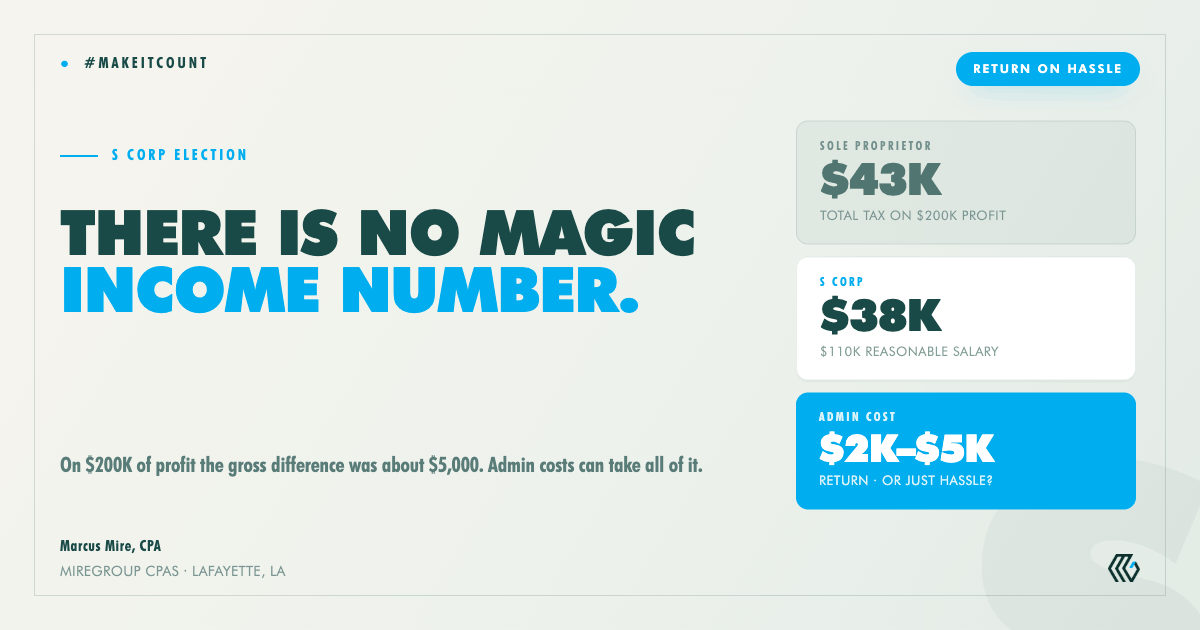
Whether that split is worth the additional filing, payroll, and administrative requirements is a separate question. We ran the full calculation on $200,000 of profit to show whether an S corp election actually saves you money, and the answer is more nuanced than the income thresholds circulating online suggest.
When do you actually pay it?
Not once a year with your return, which is the assumption that causes the most damage.
Because nobody is withholding on your behalf, self-employment tax and income tax are generally paid in through quarterly estimated payments during the year. An owner who sets nothing aside and waits for April is looking at both layers arriving at once, calculated on a full year of profit.
This is also why current bookkeeping matters for something that looks purely like a filing question. You cannot estimate what you owe on net income if nobody knows what your net income is until the year has closed.
Why does 15.3% surprise so many owners?
Because for most of their working life, half of it was invisible and the other half was withheld automatically.
An employee never writes a check for payroll tax. It leaves before the paycheck arrives, and the employer match is never itemized in a way most people register. Going out on your own removes both mechanisms at once. The full amount is now yours, it is calculated on your bottom line rather than a wage someone set, and nobody is withholding it for you.
That combination is what produces the first year surprise. The rate did not change. The visibility did.
Frequently Asked Questions
Is self-employment tax the same as income tax?
No. Marcus is emphatic on this. Self-employment tax is payroll tax covering Social Security and Medicare, and it has nothing to do with your income tax. You can owe self-employment tax on business profit and owe income tax on the same profit separately.
Do I pay self-employment tax on revenue or profit?
On net income. You subtract your deductible business expenses from revenue first, and the tax applies to what remains. In Marcus’s example, $100,000 of net income after expenses is the base.
Does an LLC by itself reduce self-employment tax?
No. A single member LLC with no S corp election is treated as a sole proprietorship, and a multi member LLC is treated as a partnership by default. Forming the LLC does not change the self-employment tax result on its own.
If I do not take money out of the business, do I still owe it?
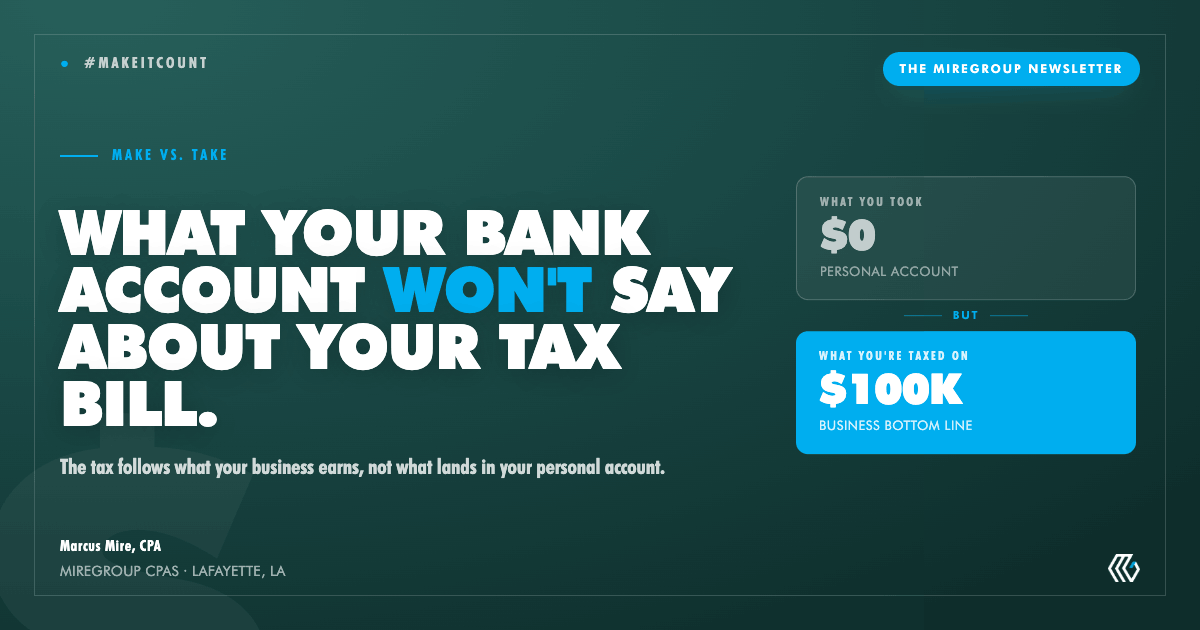
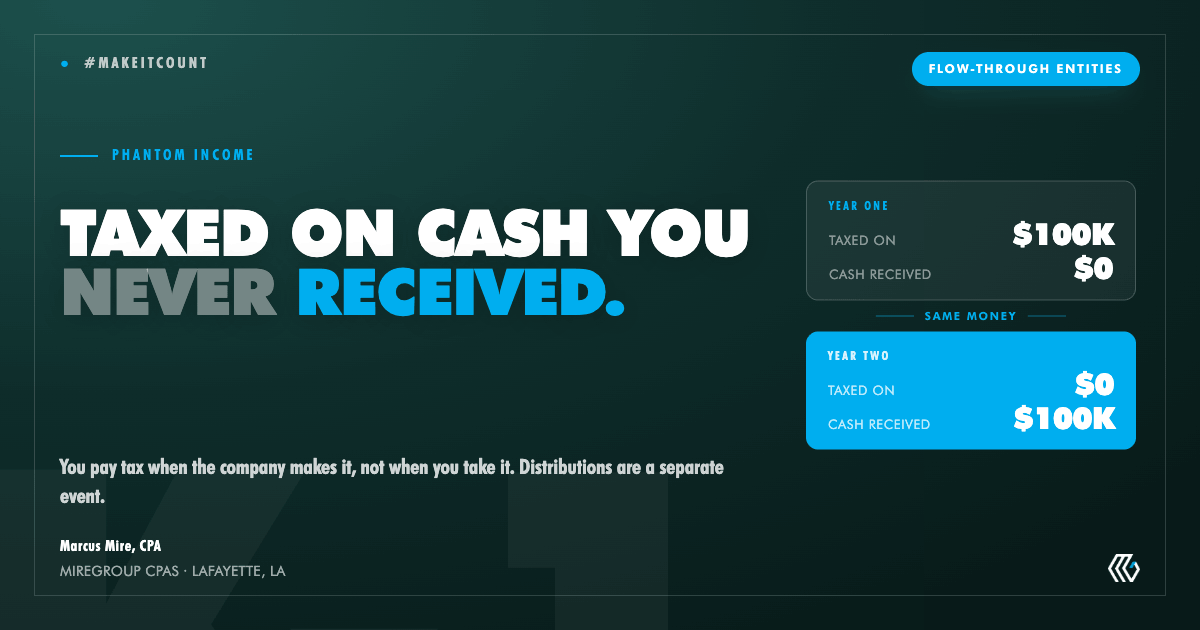
Yes. In a flow through entity, tax follows what the business earns rather than what you withdraw. Leaving profit in the business account does not defer the self-employment tax on your share.
Should I elect S corp status to avoid this?
That depends on your numbers. The election does remove self-employment tax from the distribution portion of your income, but a required reasonable salary, a reduced qualified business income deduction, and administrative costs all offset it. We walk through the full calculation on $200,000 of profit here. It is worth running the actual numbers before electing.
Want this kind of thing in your inbox? Sign up for Make It Count.

 Mire Group Marketing: Aug 18, 2026, 8:24:42 AM