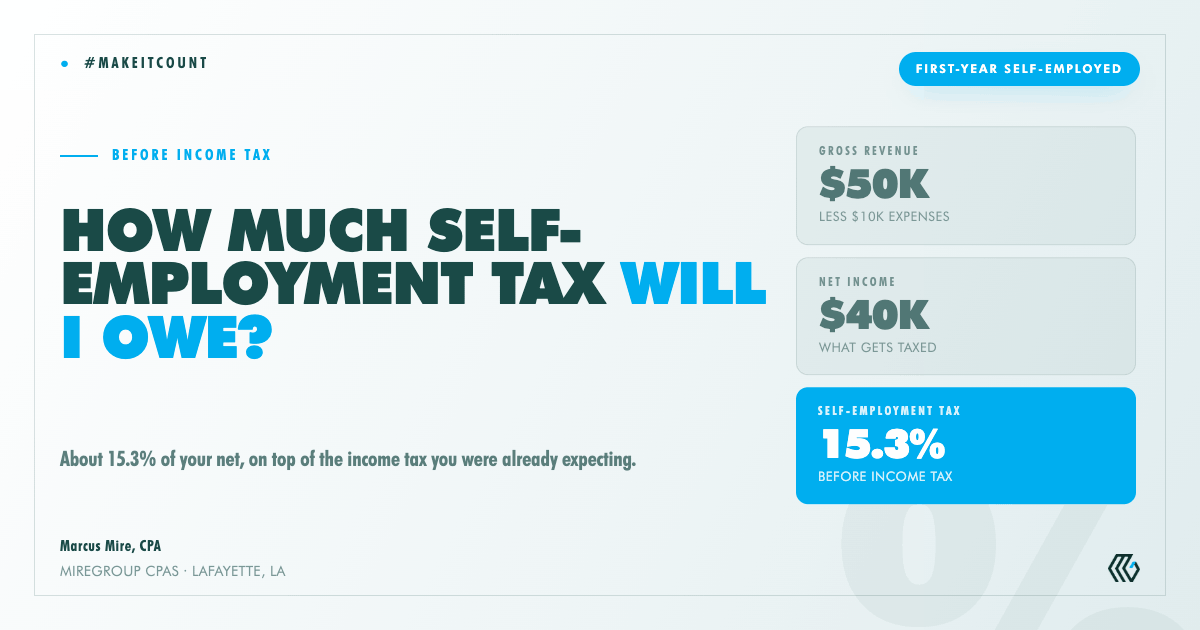
Roughly 15.3% of your net self-employment income, which is what you brought in minus your business expenses. That's before income tax. It's a separate tax that exists on top of the one most people are expecting, and it's the single biggest reason newly self-employed people get blindsided at tax time.
I'm Marcus Mire, CPA and founder of MireGroup CPAs in Lafayette, Louisiana. I get asked about this constantly, usually by someone who just finished their first year with side income and cannot understand where the bill came from.
Who pays self-employment tax?
Consultants. Lawn services. Freelancers. Anyone in the gig economy, so if you drive for Uber, this is you. Side hustles of basically any kind.
If money is coming to you directly for work you did, and there's no employer withholding anything from it, this applies.
I'm not talking about money you take out of a C corp or an S corp. Those are structured differently and the payroll piece gets handled through the entity.
How the math actually works
Let's put numbers to it.
Say you make $50,000 in gross revenue. Money people paid you. You had $10,000 of business expenses. Your net is $40,000.
Everybody understands they're going to pay income tax on that $40,000. That part is expected.
What surprises people is that you also pay self-employment tax on the same $40,000. Roughly 15% of it, gone, before income tax has entered the conversation at all.
On a $40,000 net, that's about $6,000 that most people did not budget for.
Why do I pay both sides?
Self-employment tax is the payroll tax. Understanding it means looking at what happens in a normal job.
Pull up your pay stub from a W-2 job, or look at the W-2 itself. You have Social Security and Medicare taxes withheld from your pay. Combined, that's 7.65% of your wages.
Here's the part a lot of people have never been told: your employer is matching it. They pay another 7.65% out of their own pocket on top of your wages.
So the full cost is 15.3%, split between you and the employer. You've been paying half your whole working life and never saw the other half.
When you're self-employed, you're both parties to that arrangement. You pay both sides.
That's the whole thing. There's no penalty being applied and nothing has gone wrong. The employer half that somebody else used to cover is now yours, because there is no employer.
Why it feels so different
When you work for somebody, they take the 7.65% out before you ever see the money. You never had it, so you never miss it.
Self-employed, nobody is withholding anything. The full amount hits your bank account and it all feels like yours. Then the bill arrives months later for money you already spent.
The tax was always there. The absence of withholding is what makes it feel like it appeared out of nowhere.
How much should I set aside?
Start by knowing your numbers, which sounds obvious and is where most people fall down.
What's my gross? What are my expenses, roughly? A simple spreadsheet is enough. You do not need software for this in year one.
Then apply a rate to your net. About 30% is a reasonable rule of thumb. Fifteen for self-employment or payroll tax, and another fifteen for income tax.
Pay that quarterly if you can. At absolute minimum, set it aside so it exists when the bill comes.
If you have other income pushing you into a higher bracket, 30% will be light. Closer to 40% is the safer number in that case. That sounds like a lot. It is a lot. It's also better to find out now than in April.
This is a rule of thumb, so it won't be exact. Being approximately right and funded beats being precisely surprised.
What if my withholding is also short?
If you have a W-2 job alongside your side income, you have two things happening at once. The self-employment tax on the side income, and possibly a withholding shortfall on the W-2 side. They compound.
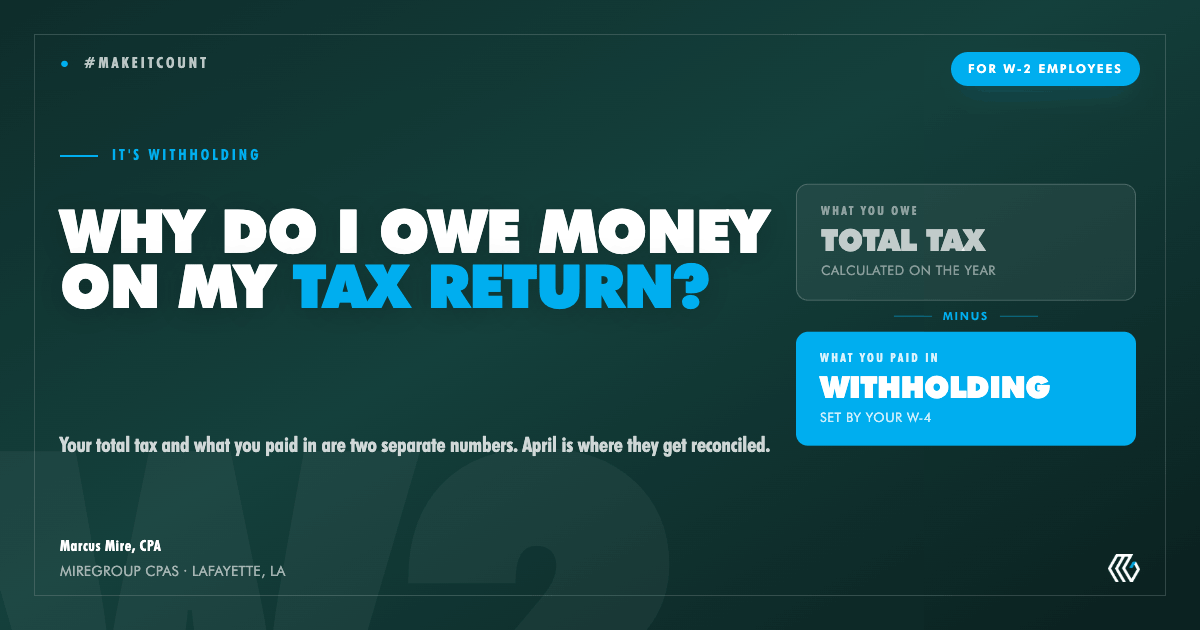
The withholding side has its own math, and I walk through it in Why Do I Owe Money on My Tax Return?
Frequently asked questions
What is the self-employment tax rate?
15.3% total. That's 12.4% for Social Security and 2.9% for Medicare, combined. It applies to your net self-employment income after business expenses.
Do I pay self-employment tax on my gross revenue or my profit?
Your net. Revenue minus legitimate business expenses. On $50,000 gross with $10,000 of expenses, the self-employment tax applies to $40,000, not $50,000. Which is one practical reason clean bookkeeping matters even for a small side operation.
Is any of the self-employment tax deductible?
Half of it is deductible against your income for income tax purposes. It softens the total somewhat. It does not reduce the self-employment tax itself.
Do I have to pay quarterly?
Quarterly estimated payments are how the system expects this to be handled, and paying quarterly avoids underpayment penalties. If quarterly is not realistic for you right now, setting the money aside is the fallback. Having it and paying late beats not having it.
Does an S corp election reduce self-employment tax?
It can, which is why it comes up so often once side income gets substantial. The mechanics involve paying yourself a reasonable salary and taking the rest as distributions, and it only makes sense above a certain income level. It's worth a real conversation rather than a rule of thumb.
If you're making money on the side and want to know what you actually owe before it's due, we'd love to help.


 Mire Group Marketing: Sep 21, 2026, 7:00:00 AM