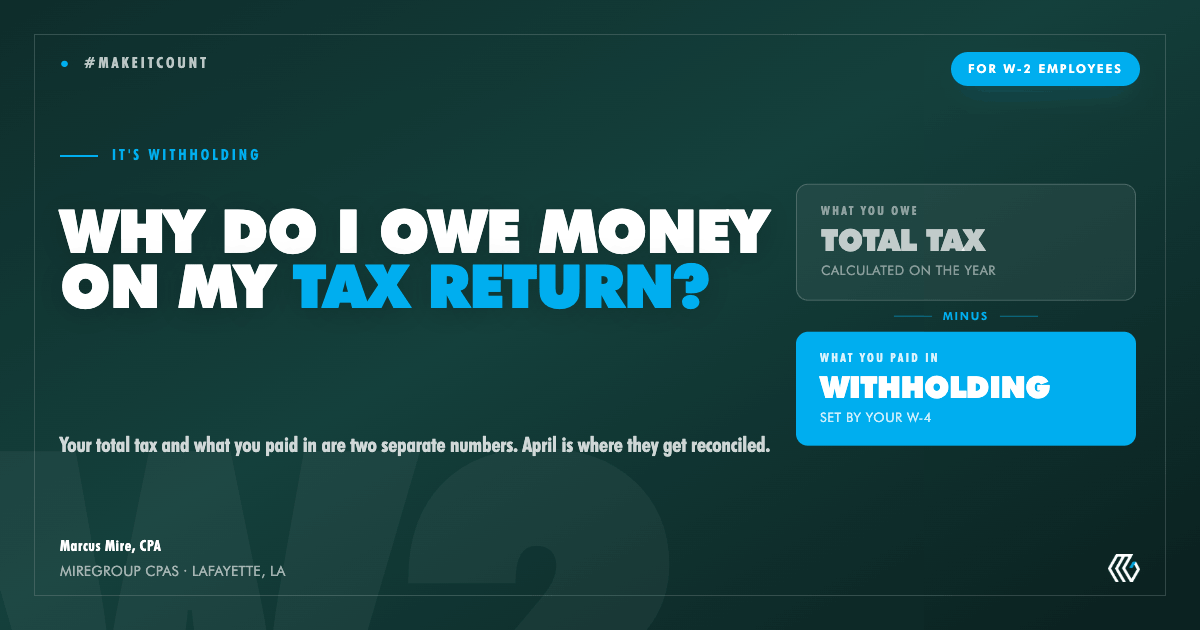
For most W-2 employees, the answer is withholding. Your total tax gets calculated on everything you earned for the year. What you paid in through paycheck withholding is a separate number entirely. When the amount you paid in comes up short of the amount you owe, you write a check in April.
I'm Marcus Mire, CPA and founder of MireGroup CPAs in Lafayette, Louisiana. This came up again recently at a football game, where a friend told me they had been hit with a bill they never saw coming and could not explain. It happens constantly.
Why did my coworker get a refund when I owe money?
I hear a version of this all the time. We do the same job, we get paid about the same, they got $10,000 back and I owe $5,000. Something has to be wrong.
Nothing is wrong. Same job is not the end of the story.
Are they married? Do they have kids? Do they give to charity? Do they have other deductions? And the one that usually explains it: do they withhold more than you do?
Two people with identical salaries can land in completely different places depending on what came out of their checks all year. The comparison feels like it should mean something, and it doesn't.
A refund is not a return
Worth clearing up, because the language trips people.
You file an income tax return. That's the document you send in. If you overpaid during the year, the government sends money back to you, and that money is a refund.
People say “I got my return back.” Once you separate the two terms, the rest of this gets easier to follow.
How do I calculate what I should be withholding?
Here's the math. You can do it in about a minute with last year's return in front of you.
Go to page 2 and find your total tax. That's your income tax after credits, including credits for children. Then go to line one, your W-2 wages.
Divide total tax by W-2 income.
That percentage is effectively your tax rate, and it's the number you need to be withholding.
Let's put a simple example to it. Say you and your spouse both have W-2 jobs and together you earned $100,000. Your total tax came out to $15,000. Divide it out and your rate is 15%.
If you did not withhold 15% of your pay, you were always going to owe money. It did not matter what your coworker did.
What about my other income and deductions?
You might be thinking, I have interest and dividends, or I have a mortgage and I itemize, or I take the standard deduction and I have kids.
All of that is already baked into the total tax number on page 2. That figure is the end of the calculation, after everything has been accounted for.
What this exercise tells you is how much needs to come out of the one source that actually has withholding attached to it, which for most households is the W-2.
One refinement worth making. Use your W-2 taxable income, meaning what's left after your 401(k) or other retirement contributions come out. That's the wage number the withholding is actually calculated against.
The two things you control
Your tax bill has a lot of moving parts. Filing status, dependents, deductions, credits, other sources of income. Most of them are just facts about your life.
Two are levers.
What you make, and what you withhold.
The second one is the one people ignore, and it's the one that determines whether April is a surprise. Separating total tax from what you paid in is the whole concept. Until those are two distinct numbers in your head, the outcome is going to feel random.
Frequently asked questions
Why do I owe taxes when I have a W-2 job and money comes out of every check?
Withholding is an estimate, and in a two income household it's often a bad one. Each employer withholds as though its paycheck is your only income. Put two salaries together and your actual rate can land higher than either employer assumed.
How do I fix my withholding so this doesn't happen again?
Run the total tax divided by W-2 income calculation, then compare that percentage to what's actually being withheld on your pay stub. If there's a gap, a revised W-4 with your employer is where you close it.
Does giving to charity mean I won't owe money?
Not necessarily. Charitable giving only helps if you itemize, and even then it reduces your taxable income rather than the bill itself. Deductions and withholding are two separate parts of the calculation, and a big deduction does not automatically cover a withholding shortfall.
Is owing money on my return a bad thing?
Not by itself. Owing means you kept more of your money during the year. The problem is the surprise, not the balance due. If you knew it was coming and set aside for it, you're fine.
What if I have income outside my W-2?
Then withholding is only part of your picture. Side income, consulting, or self-employed work brings in self-employment tax, which works differently and catches people much harder. I walk through that in How Much Self-Employment Tax Will I Owe?
If you want someone calculating this for you during the year instead of finding out in April, we'd love to help.


 Mire Group Marketing: Sep 18, 2026, 6:59:59 AM