I get this question all the time: "I formed an LLC. What does that mean for my taxes?"
The honest answer: "It depends. What's your tax classification?"
Most business owners don't know the answer. They formed an LLC because someone told them to, or because it sounds more official than just "doing business." And in one sense, they're right. An LLC does provide legal protections like limited liability, which is valuable.
But an LLC is a legal structure, not a tax category. When it comes to taxes, the IRS doesn't have an LLC tax return. What it has are three different treatments your LLC might fall under, and which one applies to you changes how you file, what you owe, and how you pay yourself.
Read on to see what's important to understand. (Or just watch this video!)
First: What the IRS Actually Sees
When you form an LLC, you're working within your state's laws. Louisiana, for example, grants LLC status under state limited liability company statutes. Your LLC exists in the eyes of the state.
But the IRS has its own framework. And in that framework, there is no LLC tax return.
Instead, the IRS looks at how many owners your LLC has and whether you've made any formal tax elections. Based on those two factors, your LLC gets classified, and that classification determines everything about how your business is taxed.
Default Treatment: Single-Member LLC
If you formed an LLC by yourself (one owner, one member) and you haven't filed any special elections with the IRS, you're being treated as a disregarded entity.
Disregarded entity is a technical term, but it means something simple: the IRS ignores the fact that you have an LLC. As far as your taxes are concerned, you're a sole proprietor.
Your income from the business gets reported on Schedule C, which is filed with your personal Form 1040. There's no separate business tax return. The LLC and you are treated as the same thing for tax purposes.
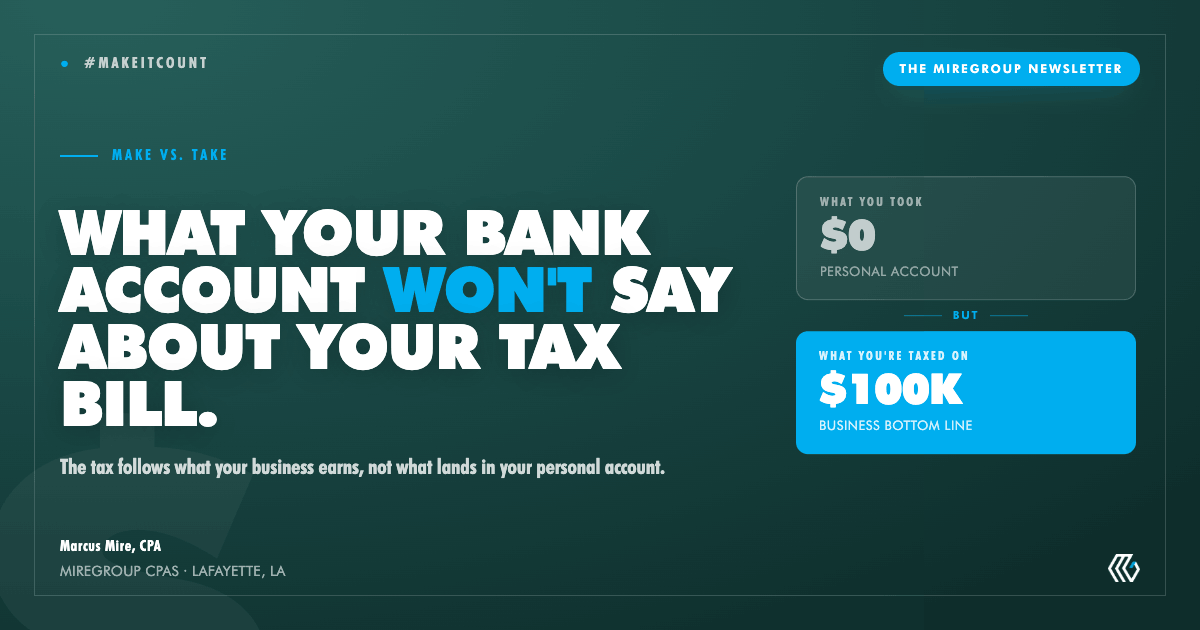
This is the starting point for most solo business owners in Louisiana, and it's not necessarily bad. But it comes with a significant downside: you pay self-employment tax (Social Security and Medicare) on all of your net profit. There's no way to reduce that exposure unless you make a different election. We break down where the 15.3% comes from and who pays it separately.
Default Treatment: Multi-Member LLC
If you formed an LLC with someone else (a partner, a co-founder, a spouse), the IRS's default treatment is different. A multi-member LLC is automatically treated as a partnership.
That means you file a partnership return (Form 1065), and each member receives a K-1 that shows their share of the income, deductions, and credits. Each member then reports their K-1 income on their personal return.
Again, this is the default. You don't have to do anything to end up here. If you formed a multi-member LLC and never filed a tax election, this is what you're doing.
Like the sole proprietorship treatment, partners in a partnership pay self-employment tax on their share of income. There are some nuances, but the general exposure is similar.
The Election: LLC Taxed as an S Corporation
Both single-member and multi-member LLCs have the option to elect S corporation tax treatment. This is where things get significantly more interesting from a tax planning perspective.
An S Corp election doesn't change your legal structure. You're still an LLC under state law. But for federal tax purposes, you file an S corporation return (Form 1120-S), and the way income flows through the business changes.
Here's the core benefit: with S Corp treatment, you only pay self-employment tax on your salary, not on all of the business's profits. Profits above your salary can be distributed to you without being subject to SE tax. For business owners with strong revenue, this can mean thousands of dollars in annual savings.
The tradeoff: the IRS requires you to pay yourself a reasonable salary. You can't pay yourself $1 a year and take $300,000 in distributions. That's the deal, and the IRS enforces it. (There's a full breakdown of how reasonable compensation works in the "How to Pay Yourself as a Business Owner" video.)
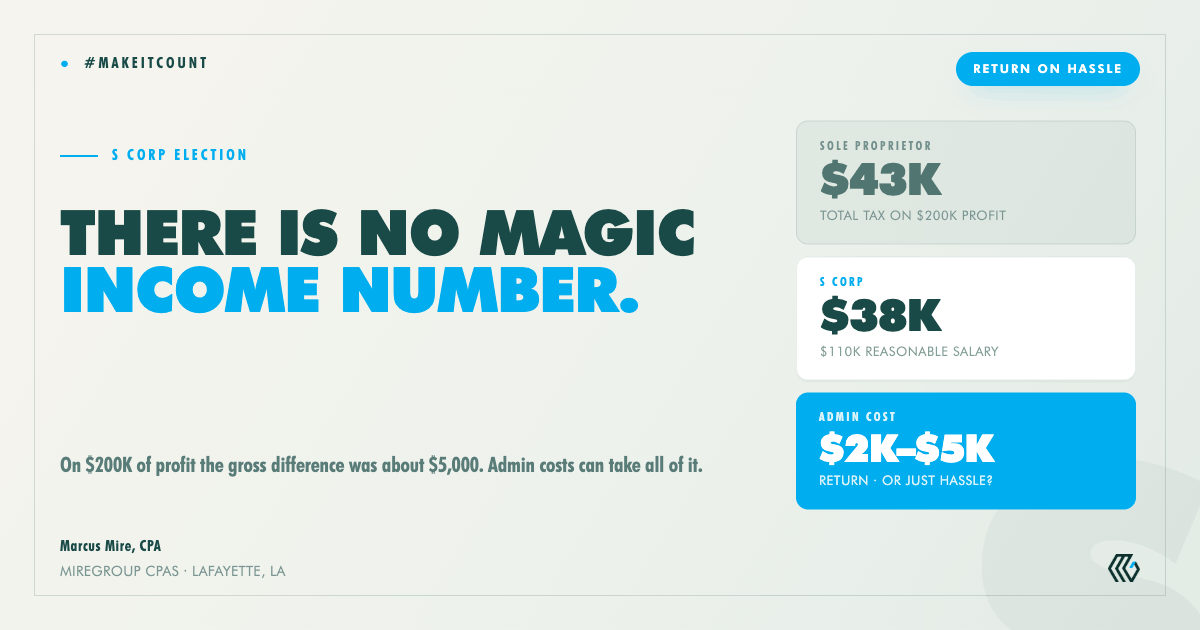
The S Corp election also comes with more administrative complexity: payroll, W2s, a separate corporate return. Whether the tax savings justify the overhead depends on your revenue level and situation, and we ran the full comparison on $200,000 of profit to show what the real difference looks like. It's a conversation worth having with your CPA before you make any moves.
So What Are You?
Here's a quick framework:
- One owner, no election filed: Single-member LLC, taxed as a sole proprietorship (disregarded entity). Income on Schedule C.
- Multiple owners, no election filed: Multi-member LLC, taxed as a partnership. Partnership return (1065), K-1s to each member.
- LLC (any number of members) with an S Corp election: Taxed as an S corporation. S Corp return (1120-S), W2 salary required for owner-employees.
Once you know your classification, the next question is usually how money moves. Here is how funding and distributions actually work. If you don't know which category you're in, that's the first thing to figure out. Look at your prior year tax returns. If you see a Schedule C, you're likely a disregarded entity. If you see a Form 1065 or 1120-S, you're in one of the other categories.
Still not sure? Ask your CPA. Or if you don't have one, that's worth addressing before your next filing.
Why It Matters More Than You Think
Your LLC's tax classification isn't just a filing detail. It affects:
- How much self-employment tax you pay
- How you pay yourself (draws, W2, guaranteed payments)
- What deductions and strategies are available to you
- How complex and expensive your annual tax preparation is
- Whether you're leaving money on the table or not
Business owners often assume their tax situation is fine because they've been filing every year. But filing and optimizing are two different things. If you've been a sole prop for years and your revenue has grown significantly, it's worth asking whether an S Corp election makes sense now.
Understanding LLCs
Forming an LLC is a smart first step. But saying "I have an LLC" doesn't tell the whole story. Your tax treatment and your actual tax exposure depend on your classification.
Single-member with no election: sole prop. Multi-member with no election: partnership. Either one with an S Corp election: S corporation.
If you're in Louisiana and want to make sure your structure is right for where your business is today (not just where it started), we'd be glad to walk through it with you.
Schedule a conversation at mire.group.


 Mire Group Marketing: Aug 18, 2026, 8:24:42 AM