Four questions came up more than anything else this month.
How does self-employment tax actually work?
Should I be an S corp?
Why do I owe tax on money I never took out of the business?
Can I move money out of my LLC whenever I want?
Different words. Same question underneath.
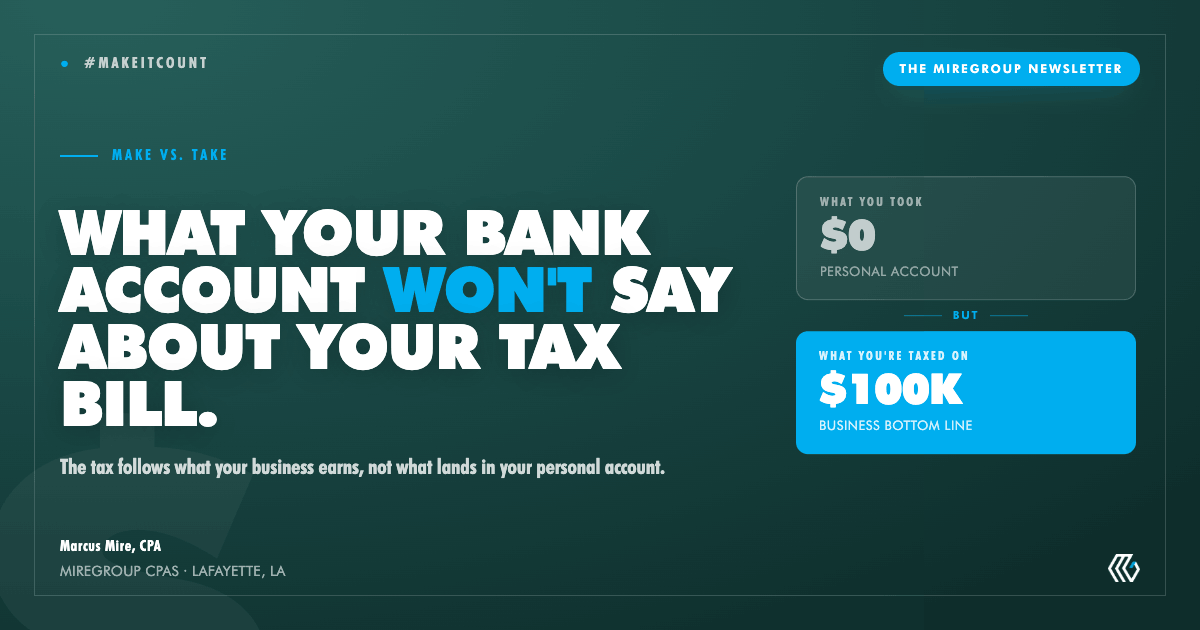
You are looking at your personal bank account. The tax code is looking at your business's bottom line. The gap between those two things is where the April surprise lives.
Here is the run through.
Want these tips in your inbox? Sign up for our newsletter here.
Self-Employment Tax
Almost everybody worked for somebody at some point. On a W-2, 7.65% comes out of your check for Social Security and Medicare. What you never saw was your employer paying another 7.65% on your wages that never showed up on the pay stub.
Go out on your own and you are both sides of that. The full 15.3% is yours, and it hits your net business income before you pay a dollar of income tax.
The rate did not change when you started your business. The visibility did.
Read it here: How Does Self-Employment Tax Work?
Money in, money out
Funding your LLC out of your own checking account is nothing, taxwise. No income to the business. No deduction for you.
Taking a profit distribution out later is generally nothing either.
The tax happens in between, when the business earns it.
You pay taxes on the money you make, not the money you take.
I walked through the whole thing on video, funding it, taking it out, and where it gets complicated.
Which is why a K-1 can show income you never saw
Say you own 100% of an S corp. After all expenses it earned $100,000 this year, and every dollar of it is sitting in the business account on December 31. You took no distributions. You personally took nothing.
You pay tax on $100,000.
That is phantom income. It runs the other direction too. There are years you pull real cash out and owe almost nothing on it, because the tax already ran the year before.
The owners it hurts are the ones who find out in April. Here is the full explanation on video.
So should you be an S corp?
You have heard you should elect at 60 or 80 grand of profit.
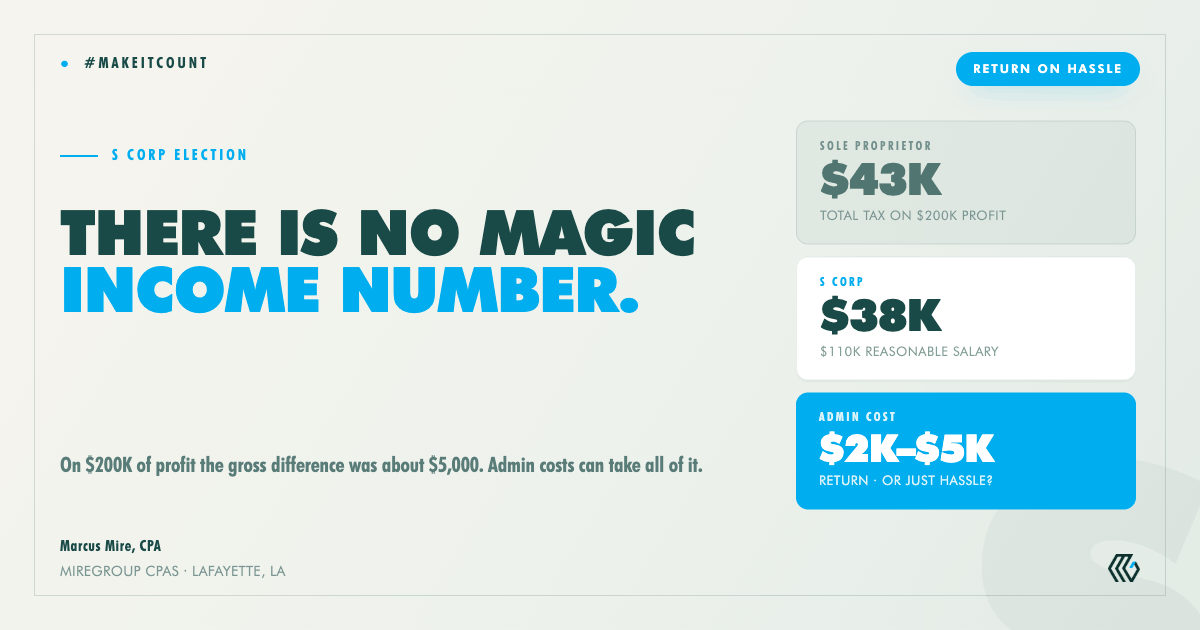
I ran a live example on a business making $200,000. As a sole proprietor, total tax came out around $43,000. As an S corp with a $110,000 reasonable salary, around $38,000.
Call it $5,000 of difference on $200,000 of profit.
Now take out the separate tax return, running payroll, and paying for payroll software. That is $2,000 to $5,000 a year in most cases. At the top of that range your savings are gone.
There is also the piece most S corp content skips right past. Paying yourself a salary drops your business income, and your QBI deduction gets calculated off that smaller number. In this example it fell from about $37,000 to about $16,000.
I call the test return on hassle. You can end up carrying every obligation of an S corp and have it do very little for you.
Read it here: Does an S Corp Election Actually Save You Money?
What all four of these have in common
Every one of them gets decided during the year.
Whether to elect. What to set aside. Whether the number landing on your K-1 is bigger than you are ready for.
By March, all of it is history and the return just reports it. The conversation that actually helps you happens in October, when your books are current and somebody is looking at them.
That is the whole model here. Fixed monthly fee, year round, so the tax conversation happens while there is still time to do something about it.
If you are not getting proactive tax planning right now, we'd love to help.
Make it count.
Marcus
P.S. If you take one thing from this issue, take this. The tax follows what your business earns, not what lands in your personal account. Every question above is a version of that.

 Mire Group Marketing: Aug 18, 2026, 8:24:42 AM