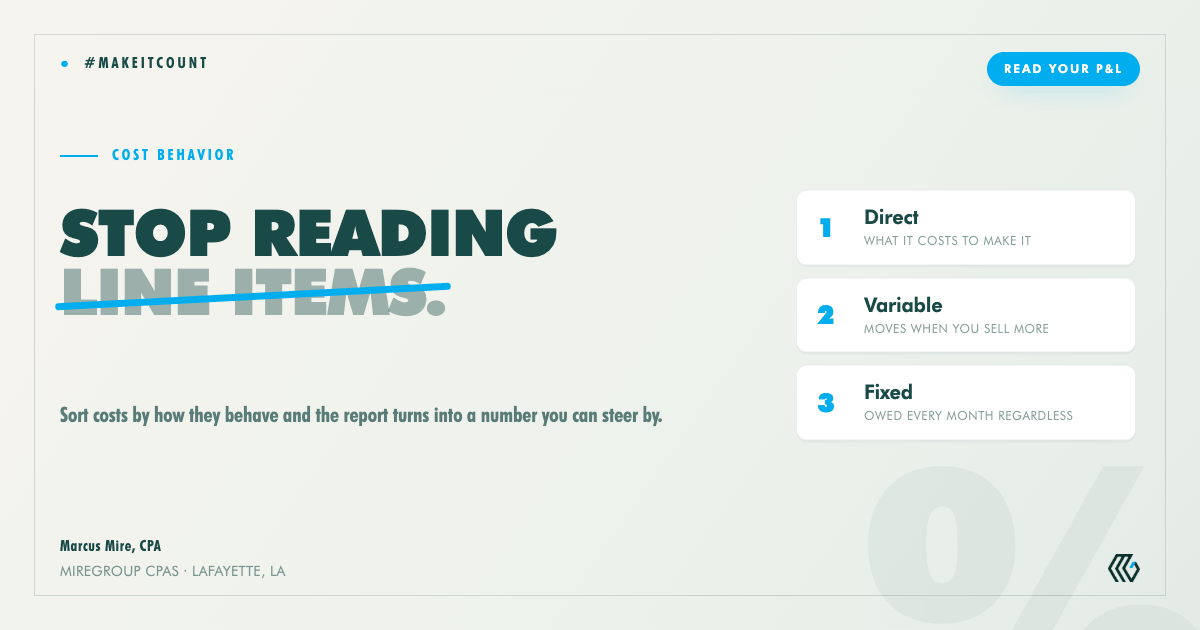
Read it for cost behavior rather than line items. The structure of a profit and loss statement runs revenue, cost of goods sold, gross profit, operating expenses, and net operating income, with non-recurring items separated below. Knowing that sequence is useful. What lets you actually run the business is sorting your costs into three groups: what it costs to make your product, what costs move when you sell more of it, and what you owe every month regardless.
Want this kind of thing in your inbox? Sign up for Make It Count.
Marcus Mire, CPA, who leads MireGroup CPAs in Lafayette, Louisiana, frames it this way from the start. His advice is to understand your P&L, and better yet, to understand specifically the things in your business that relate to your cost structure and how you make money.
What are the parts of a P&L?
The top line is revenue. If you sell tangible products, cost of goods sold comes next, and revenue less cost of goods sold gives you gross profit. Marcus treats gross profit and gross margin as effectively synonymous in this context.
Below gross profit sit your operating expenses, which you may see labeled SG&A for sales, general, and administrative expenses. Gross profit less operating expenses gives you net operating income.
Then there is a section below that, which accountants call below the line. More on that further down, because the reason it exists is more interesting than the label.
How do you sort your costs by behavior?
This is where the statement starts doing work for you. Marcus separates costs into three groups.
Direct costs are what it takes to make your product, whether that product is tangible or intangible. His example is deliberately simple: you buy something for $4 and you sell it for $9. You should know those two numbers.
Variable costs move with volume. A sales commission is his example, since it goes up as you sell more and down as you sell less. These are costs tied to activity rather than to the calendar.
Fixed costs are your overhead. Rent, normal utilities, software subscriptions, payroll. These arrive whether you had a strong month or a slow one.
Most small business P&Ls do not present costs this way. The categories on the report follow the chart of accounts, which was usually built for tax filing rather than for management. Doing the sort yourself, at least once, is what turns the report into something you can steer by.
Why does sorting costs this way matter more than the line items?
Because it produces a number you can plan against.
Once you know your gross margin per unit of sales and you know what your fixed overhead costs every month, you can work out how much revenue it takes to cover that overhead. That is your break-even point, and it is the number that makes building a budget possible in the first place. Marcus gestures at exactly this when he explains why some items get separated out, describing the ability to say if I make this much operating income, I will break even.
Reading the P&L top to bottom tells you what already happened. Knowing your break-even tells you what has to happen. Those are different tools, and only one of them helps in the middle of a month.
It also changes how you evaluate decisions. A new hire is a fixed cost, so it raises the revenue you need every month from here forward. A commission increase is variable, so it only costs you when it is working. Those two decisions feel similar on a budget line and behave nothing alike.
Sorting by behavior is the first cut. The second is sorting by segment, since a single blended P&L can hide an underperforming location or service line inside a healthy total. That is a separate exercise, and it is worth running your P&L by division or product line once the cost behavior picture is clear.
What belongs below the line, and why?
Below the line is where non-recurring items sit. Marcus’s examples are a gain on the sale of a fixed asset, or other income arising outside the normal course of your business.
His reasoning for separating them is the useful part. You would not want to include those items in operating income because they do not recur, and because they are not normal items you could project from. Selling a piece of equipment produces real income. It tells you nothing about whether your business is working.
If that gain sits inside operating income, your operating income stops being a number you can forecast against. The separation exists to protect the usefulness of everything above it.
What should you actually do with this?
Marcus keeps the ask small. Understand what it takes to make or sell your product, and then understand what your fixed and variable costs are. His view is that if you can just get to that, understanding your P&L will go a long way in helping you run your business.
For most owners that is a one time exercise with a monthly check-in, which is exactly what a regular advisory meeting is for. Pull your last full month, sort the expenses into the three groups, and work out what monthly revenue covers your fixed costs. That number is worth more than most of what shows up on the report itself.
It also depends on bookkeeping that stays current through the year. A P&L assembled in a hurry at year end can support a tax return. It cannot support this.
Frequently Asked Questions
What is the difference between gross profit and net operating income?
Gross profit is revenue less cost of goods sold, so it reflects what you make on the product itself. Net operating income subtracts your operating expenses as well, so it reflects what the business makes after overhead.
Do I have cost of goods sold if I sell services?
You may not have a traditional COGS line, but the underlying question still applies. Marcus is explicit that you should understand what it costs you to make your product whether that product is tangible or intangible. For service businesses that is usually direct labor.
How often should I look at my P&L?
Monthly is the practical cadence for most small businesses, and it is what makes the numbers usable for decisions rather than only for filing. That requires bookkeeping that stays current through the year.
What is a good gross margin?
It varies enormously by industry, so an outside benchmark is less useful than your own trend. The more valuable comparison is your margin this month against your margin over the last several months, and whether it is moving.
Why does my accountant separate certain income from the rest?
So that operating income stays projectable. Non-recurring items like a gain on selling equipment would distort the picture if they were mixed in, since they say nothing about how the business performs normally.
MireGroup CPAs handles monthly bookkeeping for small business owners so the numbers are ready when the decisions are. See how our plans work.


 Mire Group Marketing: Aug 18, 2026, 8:24:42 AM