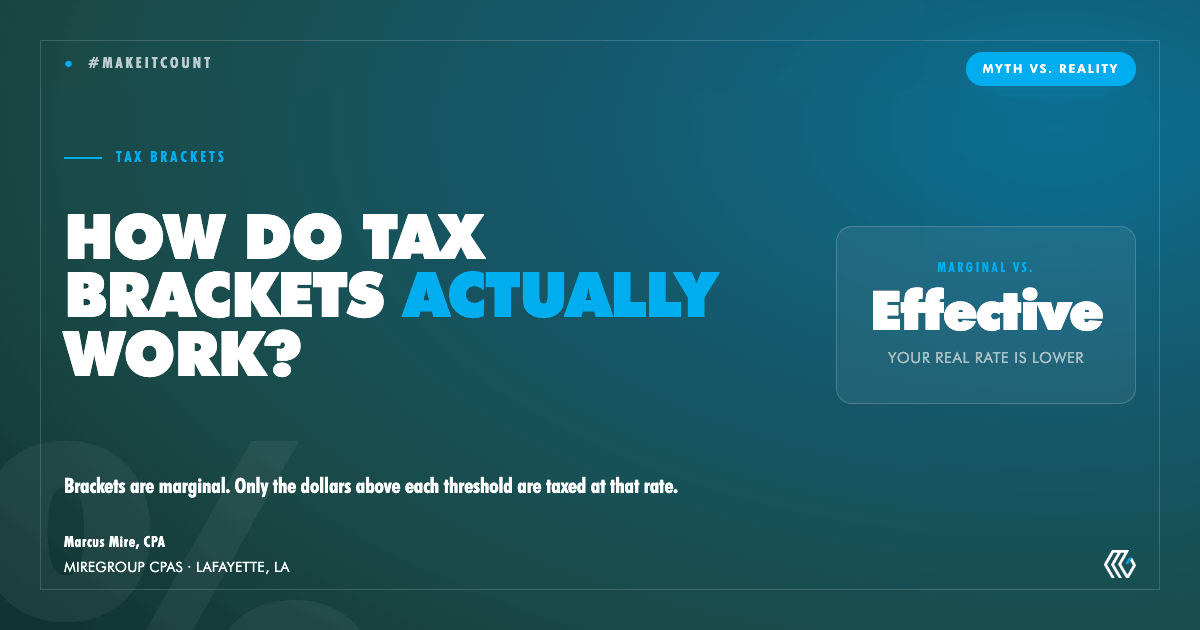
Tax brackets are progressive, which means only the portion of your income that falls within each bracket is taxed at that bracket’s rate. Moving into a higher bracket does not tax all of your income at the higher rate. It only taxes the dollars above the threshold. So earning more never means taking home less. The idea that a raise can leave you worse off is, in Marcus’s words, “nonsense” and “silly.”
Marcus Mire, CPA, founder of MireGroup CPAs in Lafayette, Louisiana, says this is one of the most confusing topics for the owners and prospects he talks to, and one of the most common myths he has to unpack. The federal system is progressive: “your tax rate goes up as you get to higher levels of income.” Some income is taxed at 10%, some at 12%, then 22%, 24%, and on up to 37%. The myth is about what happens when you cross from one band into the next.
Does making more money bump all your income into a higher bracket?
No, and this is the heart of it. Marcus gives a deliberately simple example. Say income up to $50,000 is taxed at 12%, and from $50,000 to $100,000 the rate is 20%. “It does not mean that once you make $51,000, that all of your money is taxed at 20%,” he says. “It just means the portion that exceeded the last bracket is taxed at that rate.” So in that example, only that extra $1,000 is taxed at 20%, and the first $50,000 is still taxed at 12%. Those are not real brackets, just clean numbers to make the point.
This is exactly why he pushes back on a line he hears all the time: “I don't want to make any more money this year, it's going to put me in a higher tax bracket.” His response: “That is nonsense. That's silly.” Every extra dollar you earn costs only a fraction in tax. If a dollar in the higher band costs 20 cents, you keep 80. Eighty cents is not as good as the 88 you keep at the lower rate, but it beats not making the dollar at all. You never come out behind by earning more.
A worked example, start to finish
Marcus runs the full math on another simple set of numbers. Say the 10% bracket covers taxable income from $0 to $10,000, and the 12% bracket covers $10,000 to $20,000. If you made $20,000, you pay 10% on the first $10,000, which is $1,000, and 12% on the next $10,000, which is $1,200. Your total tax is $2,200. Not the whole $20,000 at the top rate. Just each slice at its own rate, added together.
What’s the difference between your marginal rate and your effective rate?
This is the concept underneath Marcus’s example, and it is worth naming. Your marginal rate is the rate on your next dollar, the top bracket you reach. Your effective rate is your total tax divided by your total income, the true average across every slice. Because the lower brackets are always taxed at their lower rates, your effective rate is always lower than your marginal rate. When someone says they are in the 22% bracket, they are not paying 22% on everything. Their average is lower, and that average is what actually describes their tax burden.
Why does this matter for planning?
Because once you stop fearing the bracket line, better decisions follow. You take the raise. You take the bonus. You accept the profitable project. And on the planning side, knowing your marginal rate is what makes the rest of tax strategy work: a deduction is worth more in a year when your marginal rate is high, and timing income and expenses around your brackets can move real money. Understanding how brackets actually work is the starting point for almost every planning conversation that follows.
Get the free guide. You Don’t Need a Loophole. You Need These 7 Principles is the fastest read on why boring, consistent tax habits beat hunting for a magic write-off. Subscribe to Make It Count and we’ll send it over: mire.group/newsletter-signup
Want your brackets working in your favor year-round instead of being a source of anxiety? We walk through the whole thing here: mire.group/accounting-and-tax-plans.
Frequently Asked Questions
If I move into a higher tax bracket, is all my income taxed at that rate?
No. Only the income above the bracket threshold is taxed at the higher rate. Everything below it is still taxed at the lower rates. Earning more never reduces your take-home pay.
Should I turn down a raise or bonus to avoid a higher bracket?
No. Marcus calls that idea nonsense. Every extra dollar costs only a fraction in tax, so you always come out ahead by earning it, even if part of it lands in a higher band.
What is the difference between marginal and effective tax rate?
Marginal is the rate on your next dollar of income. Effective is your total tax divided by total income, the average. Your effective rate is always lower than your marginal rate.
Why did so much get withheld from my bonus then?
That is withholding, not your tax rate. A bonus is withheld at a flat supplemental rate, which is a separate issue from the marginal brackets. See our companion post on how bonuses are taxed.
How do brackets affect my tax planning?
They shape the value of deductions and the timing of income and expenses. A deduction saves more in a high marginal-rate year, which is why understanding your bracket is the first step in planning.



 Mire Group Marketing: Oct 8, 2026, 12:08:35 PM