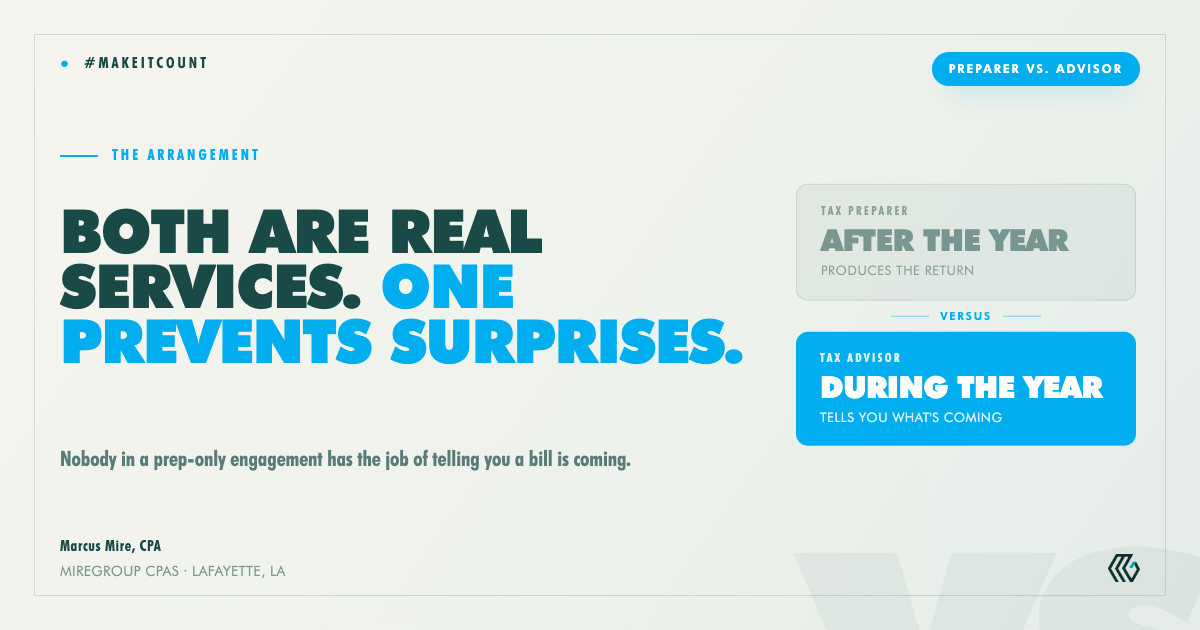
A tax preparer takes your documents after the year has closed and produces a return. A tax advisor works with you during the year, calculates what you're going to owe before it's due, and answers your questions along the way. Both are legitimate services. Only one of them can keep you from being surprised.
I'm Marcus Mire, CPA and founder of MireGroup CPAs in Lafayette, Louisiana. The surprise tax bill is the number one thing that frustrates people in what we do, and after enough years of hearing about it I've come to think the problem is usually the arrangement rather than the person.
What a preparation engagement actually is
Look at the service on its own terms.
You gather your documents after year end. You hand them over. You get back a completed return that tells you whether you owe or you're getting money back.
That's the deal. There's no understanding built into it, no nuance, no questions asked along the way, because none of that is what you bought.
I'm not knocking preparers at all. There are a lot of good CPAs here in town doing this work, and some of them are friends of mine. The service does exactly what it's designed to do.
But nobody in that arrangement has the job of telling you a bill is coming. There's no point in the calendar where that conversation is scheduled to happen.
So when people get blindsided, the structure produced that outcome. It was going to produce it eventually.
Why the surprise is the real problem
Most people only talk to me after they've been surprised.
That's how this comes up. Somebody owed money they didn't expect, they don't understand why, and now they want to know what happened.
Nobody sees a $20,000 tax bill land and feels fine about it. And the frustrating part is that in almost every case, the number was knowable months earlier. The information existed. There was just nobody assigned to look at it and pick up the phone.
What an advisory engagement looks like
Someone whose job it is to collect information from you throughout the year. Someone running the calculation while there's still time to act on it. Someone telling you what you'll owe, and either helping you pay it quarterly or at minimum making sure you know the number.
That's the whole difference. The work is happening during the year rather than after it.
Here's how we handle it. We really don't work with people who won't let us do advisory for them. We have a handful, every firm does, but it isn't the practice we run.
For our clients we're calculating quarterly what they should be paying in. They might not pay it, and that's their call to make. But when we get to the end of the year and the number is $30,000, they knew about the $30,000. Nobody is finding out in April.
This is also the thinking behind regular advisory meetings. The cadence is what makes the whole thing work.
How to ask your CPA for this
Pricing in this profession is murky, and how firms package advisory varies a lot. We do everything by fixed fee and sell it in packages, which is a deliberate choice, but plenty of good firms structure it differently.
If you have a CPA you like, ask them directly. Tell them you want an advisory engagement. Say you want to pay them to be available throughout the year, to help you understand your tax bill, to answer questions, and to keep you prepared rather than surprised.
If your current provider doesn't package it that way, you have to ask for it. It won't be offered by default, because you've already bought something else.
What changes once you're in that arrangement
You start understanding your own tax situation. Not in an abstract way, in the specific way that comes from seeing the numbers more than once a year.
Then you start asking better questions.
And then the outcomes stop being surprising, because you've been watching them develop.
Eventually you get somewhere more interesting. You move past “what do I owe” and land on “are there ways to owe less.” The answer to that is yes, and that's where proactive tax planning starts being worth what it costs. You need a foundation before planning means anything.
Most people arrive at this backwards. They start with getting their taxes done, take an unwelcome surprise, and decide they want something different.
At a minimum, move to advisory with a tax calculation during the year and some real meetings on the calendar. Layer proactive planning on top of that as you graduate into it.
That's how it works, and that's what we do for our clients. We don't hand something back and disappear until next February.
Frequently asked questions
Is a tax advisor more expensive than a tax preparer?
The annual fee is higher, because you're buying access and ongoing work instead of a single deliverable. Whether it costs you more depends on what the surprises and the missed planning were costing you already.
Can my current CPA do advisory work?
Usually yes. Most CPAs are capable of it, and many offer it without leading with it. Ask directly rather than waiting for it to be proposed.
What should an advisory engagement include at minimum?
A tax calculation during the year rather than after it, quarterly guidance on what to pay, and scheduled meetings where you can actually ask questions. Anything less than that and you're still going to get surprised.
Do I need this if my taxes are simple?
Not necessarily. A straightforward W-2 situation with no side income and stable withholding may not need much. The moment you add self-employment income, an entity, rental property, or a big swing in income, the calculation stops being simple and the surprise risk goes way up.
What's the difference between tax planning and tax preparation?
Preparation reports what already happened. Planning changes what happens next, and it requires knowing the numbers while the year is still open. You cannot plan in retrospect.
If you're tired of finding out what you owe after it's too late to do anything about it, we walk through the whole thing here.


 Mire Group Marketing: Sep 14, 2026, 7:00:01 AM