Your tax return is a scoreboard.
It tells you what happened. How much you made. How much you owe. Whether the year went well or went sideways. And just like a scoreboard, by the time you’re reading it, the game is already over.
Most business owners spend tax season staring at the scoreboard. Gathering documents. Handing them to their CPA. Waiting for the number. Reacting to the number. Maybe feeling good, maybe feeling sick. Then moving on until next year.
But the business owners who consistently come out ahead? They’re not studying the scoreboard. They had a game plan. They made strategic decisions during the year (not after it) based on real data and real projections. By the time filing season rolls around, their return is just confirming what they already knew.
That’s the difference between tax preparation and tax planning. And it’s bigger than most people realize.
Over the past few weeks, we’ve been breaking this down. Here’s what we’ve covered.
Know the Difference: Planning vs. Preparation
Tax preparation is compliance. Your CPA takes your financial data from the prior year, organizes it, and files an accurate return. That’s essential work. You need it done right.
But it’s backward-looking. By February or March, the year is closed. The decisions have been made. Your CPA is looking in the rear-view mirror.
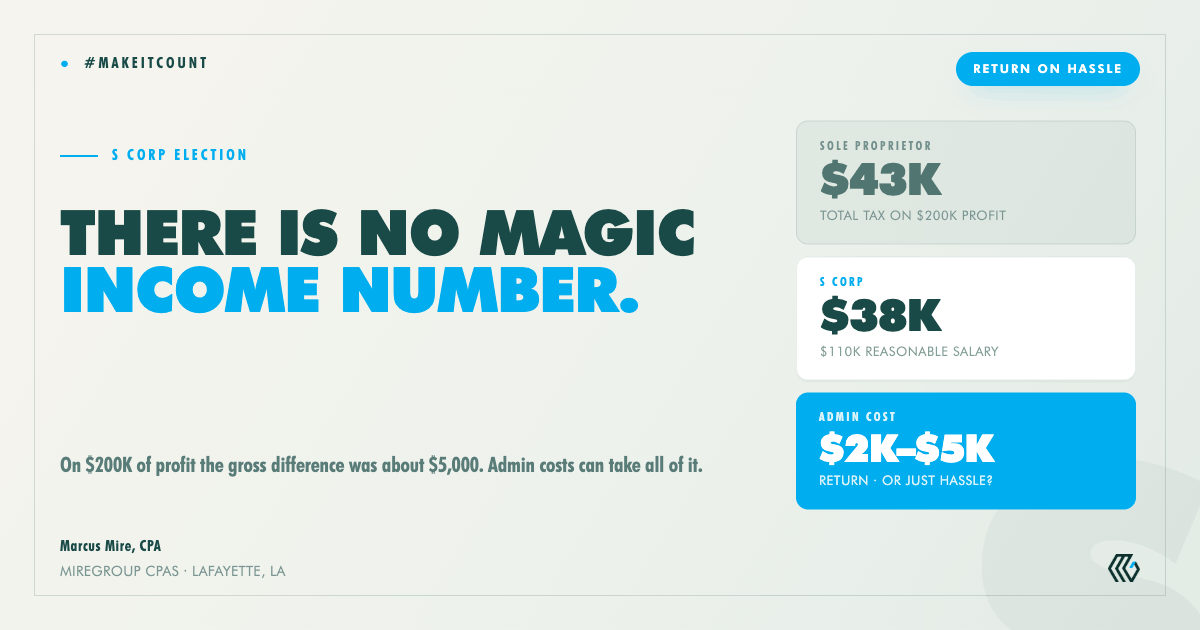
Tax planning is what happens before December 31st. It’s walking alongside a professional who understands your business, your numbers, and your goals. It’s having conversations in July about decisions you’re making in October. It’s optimizing your salary for the Qualified Business Income deduction, structuring retirement contributions strategically, evaluating pass-through entity elections, and doing all of it based on where the data says you’re actually headed, not where you hope you’ll land.
If the only time you interact with your tax professional is during filing season, you’re getting preparation. That’s not a knock on anyone. But it means the biggest opportunities have probably passed by the time you sit down together.
And if you’re a Louisiana business owner, the distinction matters even more right now. The state’s recent tax overhaul: flat 3% individual rate, tripled standard deduction, new state-level bonus depreciation, and the full repeal of the corporate franchise tax coming in 2026, creates real planning opportunities. But opportunity only exists if someone is looking through the windshield.
Read more: Tax Planning vs. Tax Preparation: What’s the Difference →
Two Moves You Can Still Make
The game plan window for 2025 closed on December 31st. That’s where most of the real savings opportunities lived. But the scoreboard isn’t completely locked yet.
There are exactly two contributions you can make right now, in 2026, that still count on your 2025 return. Both have a hard deadline of April 15th. No extensions.
IRA contributions. Up to $7,000 if you’re under 50. $8,000 if you’re 50 or older. A Traditional IRA reduces your taxable income now. A Roth doesn’t give you the upfront deduction, but withdrawals in retirement are tax-free. Which one makes sense depends on where your tax rate is headed—worth talking through with your CPA before you file.
HSA contributions. If you’re on a high-deductible health plan, you can contribute roughly $4,300 for individual coverage or $8,550 for family. The HSA offers a triple tax advantage: deductible contributions, tax-free growth, and tax-free withdrawals for qualified medical expenses. After 65, it essentially functions like a Traditional IRA for any purpose. Most people underutilize it.
These are the exceptions, not the rule. If these are the only moves available to you right now, take them—and then ask yourself what it would look like to have more options next year.
Read more: Two Tax Moves You Can Still Make →
What the Game Plan Actually Looks Like
So if the scoreboard-only approach leaves money on the table, what does the alternative look like?
It starts with the foundation. Not the strategies. The foundation.
Clean books. Accurate, timely financial data. The kind of data that lets your CPA advise with precision instead of generic rules of thumb. Because when your numbers are reliable, the strategies get specific: salary optimization instead of “buy something before year-end.” Calculated retirement contributions instead of a last-minute scramble. Real analysis instead of guesses.
And when the data isn’t there? That’s when you get lazy tax planning. “My CPA said I need to buy something to get a write-off.” So someone spends $80,000 on a truck they didn’t need, saves maybe $28,000 in taxes, and is still out $52,000 in cash.
That’s not a game plan. That’s just spending money.
The business owners who save the most aren’t the ones with the cleverest tricks.
They’re the ones who built the infrastructure—good data, good systems, a professional working alongside them all year—so that when December rolls around, the decisions are already made and the savings are already locked in.
Read more: Tax Planning That Actually Works →
Make This the Last Reactive Tax Season
Tax season doesn’t have to feel like damage control.
The business owners we work with don’t scramble. They don’t panic. They walk into filing season already knowing where they stand—because the conversations have been happening all year. The scoreboard just confirms the game plan.
If this year feels rushed, reactive, or like you’re just checking a box—that’s not a failure. That’s a signal. And the time to change it isn’t next February. It’s now.
Build the foundation. Make the game plan. Then watch the scoreboard take care of itself. Book time with me here, and I'm glad to talk through your game plan.


 Mire Group Marketing: Aug 6, 2026, 11:21:10 AM