Most small businesses start by using AI like a search engine: research, emails, quick summaries. The bigger payoff comes when you give AI a repeatable set of instructions and connect it to your real data, so it runs tasks for you on a schedule. At MireGroup CPAs we use Claude that way for admin and marketing work. One build alone saves me at least five hours a month.
I'm Marcus Mire, CPA and founder of MireGroup CPAs in Lafayette. I'm going through an AI course right now, and it lays out a simple way to think about where your business is with AI.
What are the stages of AI use in a business?
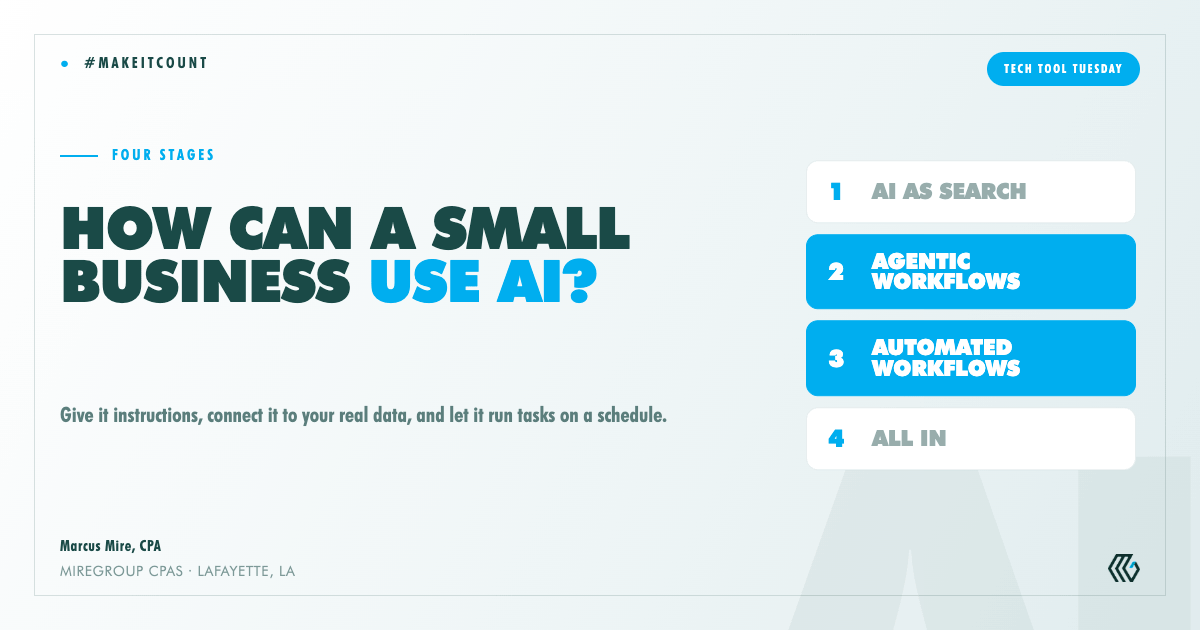
- AI as search. You ask it things, like Google. You use it for research, to help write emails, or for general feedback.
- Agentic workflows. You give AI a set of instructions and it gets work done for you.
- Automated workflows. You take that a step further. AI has set tasks it runs on a daily basis, and there's more than a handful of them.
- All in. AI agents and automated workflows handle roles on your team and work around the clock.
So where are you?
Where is MireGroup on that scale?
We're somewhere between stage two and stage three.
We started where a lot of people start, with ChatGPT. Research this for me. Revise this email. Make an itinerary for a trip. Now we use Claude, and we're getting it to do real tasks, including scheduled tasks that run on their own.
For us, most of that is administration and marketing. We haven't leaned on Claude as much for our technical accounting work. The admin side is where it's paying off first.
What does AI actually do for us?
Production tracking. We track what each employee produces and assign it a value. That used to be a manual process pulling from multiple data sources: combining, editing, parsing, adding formulas. Now I feed Claude one data source and it spits out the production calculation. That alone saves me at least five hours a month.
Keeping prospects on our newsletter list. Claude pulls our prospect data from Airtable, checks it against HubSpot, and makes sure every prospect lands on our newsletter list so we can market to them.
Checking invoicing data. Claude looks at invoicing data in Airtable and checks it against Xero.
Cash flow projections. Claude is connected to Xero, our accounting software. I tell it to build a cash flow model for a set of dates and it takes about a minute. (A projection is only as good as the plan behind it. If you don't have one yet, start with a budget.)
And, like a lot of people, we use it for the low-hanging fruit. Research, email revisions, summarizing data, analyzing data, flagging outliers and duplicates.
Several of these run on saved instructions called skills. We break down how we built them here.
Should AI save you time or add value?
Both. Some of our AI work saves real hours, like that production calculation.
The other kind is easier to miss. That Airtable-to-HubSpot sync is a task nobody on our team was doing. I wouldn't have done it, or I would have had to put a person in charge of it. Now it happens every day, and it's tied directly to marketing and sales.
When you look for AI use cases, look for both. What eats your time? And what would you do if you had someone to do it?
Which AI plan should a small business use?
For us, it's Claude, and we're on the Team plan. Get on one of the paid business plans, Team or Enterprise, with Claude or ChatGPT. Those plans don't use your data to train their models by default, and that's where you get the higher levels of security.
Frequently asked questions
What's the easiest way to start using AI in a small business?
Start with the low-hanging fruit. Research, revising emails, summarizing data, and finding outliers or duplicates in a spreadsheet. Once that's comfortable, pick one repeatable task and give AI a set of instructions to do it for you.
Is AI going to replace people on my team?
That's stage four, and some businesses are heading there. For us, the bigger win has been adding work we never had time for, like keeping every prospect on our newsletter list. So far it has added value without replacing anyone.
Which AI does MireGroup CPAs use?
We use Claude on the Team plan. We started with ChatGPT like a lot of people, and moved to Claude as we started building repeatable tasks and connecting it to our apps.
Is it safe to put business data into AI?
Use a paid business plan, like Team or Enterprise from Claude or ChatGPT. Those plans don't use your data to train their models by default and come with higher levels of security. Free and individual plans have different defaults.
How long does it take to set AI up for a real task?
Our production calculation took me four or five hours to build. It saves me at least five hours every month. The time goes into teaching it your rules up front. After that, you just refine it when something changes.
AI works best on clean, current books. If yours aren't there yet, that's where we start. We walk through the whole thing here.

 Mire Group Marketing: Oct 8, 2026, 12:08:35 PM