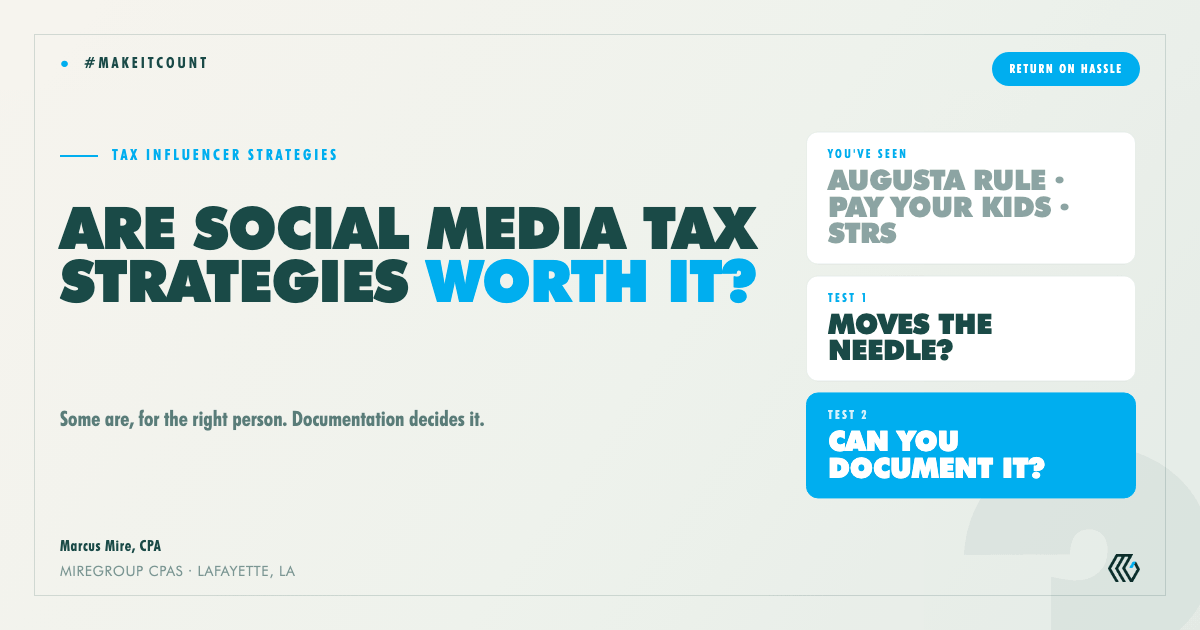
Some are, for the right person. The test is whether the strategy moves the needle financially and whether you're willing to do the documentation it requires. The Augusta rule, hiring your kids, and short-term rentals with cost segregation are all real strategies. Without records kept as you go, though, each one leaves you with an aggressive position you can't defend in an audit.
I'm Marcus Mire, CPA and founder of MireGroup CPAs in Lafayette, Louisiana. I keep seeing more and more videos on Facebook and TikTok from what I'd call tax influencers. Pay your kids. The Augusta rule. Short-term rentals with cost segregation studies. I want to give you some sobriety around how these actually work.
What is return on hassle?
It's a concept we talk about with our clients at MireGroup. Whatever strategy you use, make sure it's worth the trouble.
That comes down to two questions. Does it move the needle financially? And can you document and substantiate it? If the answer to both is yes, you're probably looking at a good strategy. We touch on the same idea in how to avoid a surprise tax bill: make tax moves that are also good business moves.
Is the Augusta rule worth it?
Oftentimes not. For the right client, yes.
Here's the gist. Your business rents your home from you. The rent your business pays you personally isn't taxable to you, and it's deductible to your company. The rule allows this for up to 14 days a year, and the rental has to be for real business use, like a meeting.
The catch is the rent. I saw a video where somebody said you could price it like an event rental to come up with the comps. This guy was using $10,000 a night.
First, that's probably not the case. Second, say you look up the comps in your area and they're $100 a night. What have you really done with a strategy you now have to document and prove?
If it's worth it for you, document it. Paper it up.
Should you put your kids on payroll?
Not always. We see people all the time who want to employ their kids. We ask how old the kids are. They say 3.
What could your 3-year-old do for the business? Modeling for social media has kind of been ruled out. If you wouldn't pay somebody else's 3-year-old $10,000 to model, you wouldn't pay your own 3-year-old $10,000 either.
In the cases where it does make sense to pay your kid instead of somebody else, document it. Pay them a reasonable wage. Pay them as a W-2 employee. Paper it up.
What about a short-term rental with a cost segregation study?
The crux of the short-term rental loophole is that your average stay is 7 days or less. If you're not willing to document that, you're going to have a hard time proving you have a short-term rental in an audit.
You also have to materially participate, and document that too. The whole point is to get a cost segregation study, accelerate the depreciation, and create a big paper loss that offsets your W-2 or business income. If you won't do the work behind it, it's not worth the trouble. We run the actual numbers on a cost seg study here.
What happens if you skip the documentation?
If you want to use advanced tax strategies but you're not willing to do the documentation, you're in no better position than if you'd never done the strategy at all.
Here's why. These strategies need contemporaneous records, meaning records you keep as you go. If you get audited without them, you have no leg to stand on. You're left with an aggressive position you can't document, or won't.
Lots of accountants will go along with it because they're busy. They'll take your word for it that you drive 90% for business. But if you're throwing something at your accountant on the back end to see if it sticks, chances are you're not in a good position to defend it in an audit.
Look. We want to do everything that makes sense from a legal and tax perspective. We want to take advantage of every loophole, or whatever you want to call it. So use strategies that move the needle financially, and use a reputable professional you're paying to help you monitor and document the position. Same principle as buying equipment just for the write-off: the economics come first.
Frequently asked questions
Is the Augusta rule worth it?
Oftentimes not, but for the right client, yes. It depends on what a fair rent for your home actually is. If comparable rentals in your area run $100 a night, the deduction may not justify the documentation you have to keep.
Can I pay my young kids to model for my business's social media?
That's been mostly ruled out. The test is whether you would pay somebody else's child the same amount for the same work. If you wouldn't pay another 3-year-old $10,000 to model, you can't justify paying yours.
What are contemporaneous records?
Records you keep as you go, instead of rebuilding them later. Mileage logs, rental stay records, and hours worked on a property are examples. In an audit, they're what lets you defend the position.
If my accountant signed off on a strategy, am I safe?
Not necessarily. Plenty of accountants are busy and will take your word on things like business use of a vehicle. If the records aren't there, you're the one exposed in an audit.
Saw a strategy online and want to know if it's worth the hassle for you? We'd love to help.


 Mire Group Marketing: Oct 27, 2026, 11:20:10 AM