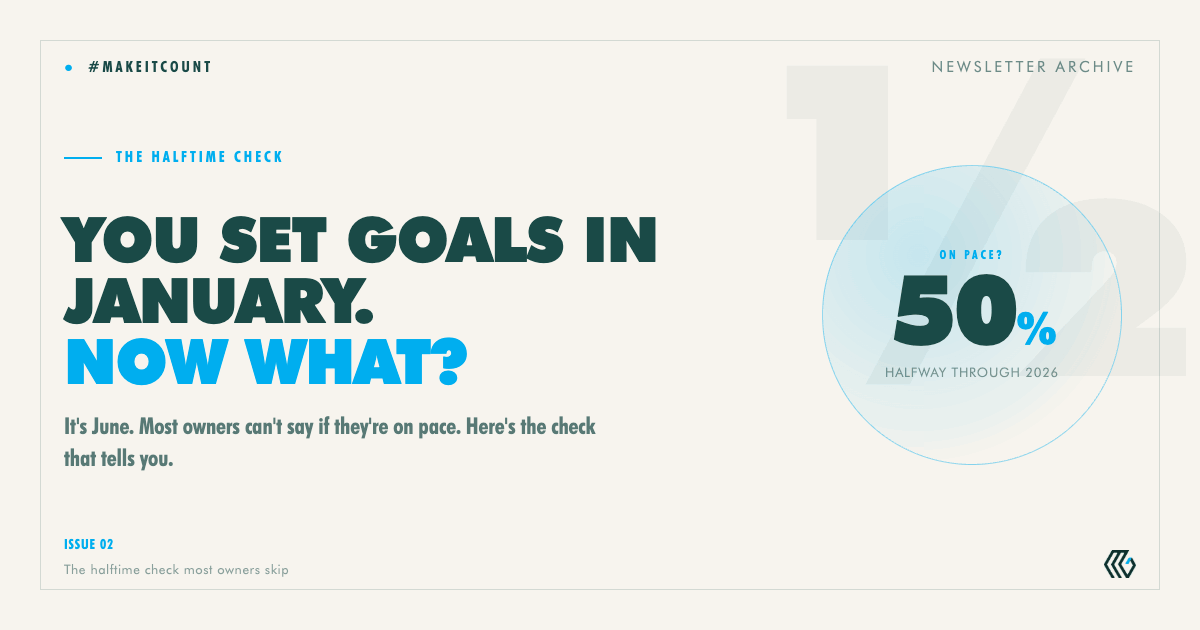
We are slowly but surely approaching the halfway point of 2026. Back in January, you probably set some targets. A revenue number. A profit goal. Maybe a hire you wanted to make or a debt you wanted to pay down.
The question that matters right now: are you on pace?
Most business owners cannot answer that with a real number. Because the system that would tell them was never put in place.
We have written a lot lately about the pieces of that system. Here they are in one place, in the order they actually matter. Pull up your numbers as you read.
Start With the Floor, Not the Goal
Before you ask whether you are winning, ask whether you are protected. In our latest piece, we put a real number on it: a static cash balance, a floor your checking account should never drop below. The target is 60 to 90 days of cash outflows, and the calculation has to include the things your P&L hides, like loan principal payments and inventory. Most owners run without that number. That's like driving without a fuel gauge. You might be fine. You just won't know until you're not.
Read it: How Much Cash Should Your Business Keep in the Bank?
You Can't Be Off Track Without a Track
On pace compared to what? That is the catch with checking your progress in June if you never put the plan into numbers. A budget is that plan. A budget is a mirror. It doesn't lie. Put your revenue goals and expected costs on paper on purpose, then hold them up against what actually happened through the first five months. The gaps are where the real conversation starts. You can't manage what you don't measure.
Read it: Why Your Business Needs a Budget
Read the Scoreboard, Not Just the Final Score
Your P&L is where you read how the year is going. The trap is the single blended number. Revenue up, expenses reasonable, close the tab, move on. But that blended view hides which parts of the business are carrying the rest. I've seen owners discover that the product line they assumed was their bread and butter was actually their worst performer once labor was counted, while a quiet side project held the best margins in the company. Segment your P&L by location, service line, or product, and the truth shows up.
Read it: Get More From Your P&L
Three Numbers Beat Thirty
You don't need a wall of metrics to know whether you are winning. For a service business, focus on three: average revenue per client, median revenue per client, and number of active clients. More customers is the wrong goal. I have seen owners double their client count and barely move the bottom line. That is not growth. That is a treadmill. Halfway through the year is the right time to ask whether you need more clients or better ones.
Read it: 3 KPIs for Service Business Growth
Halftime Only Helps If Someone Is Watching
None of this works if you only look once a year. The moves that change your tax bill do not happen in March. They happen in July, when you notice income is tracking higher than projected. They happen in October, while there is still time to act. That is the whole idea behind year-round advisory: someone in your numbers all year, so April holds no surprises. Some of you already work this way with us. If you don't, June is a good month to start.
Read it: What Is Year-Round Tax Advisory?
Here is the good news about halftime: there is still a half left to play. A floor protects you. A budget gives you the plan. A segmented P&L shows you the truth. The right KPIs tell you if you are winning. And someone watching year-round keeps April from catching you off guard. You do not need a crystal ball to know whether your year is on track. You need the numbers in front of you.
Make it Count,
Marcus Mire, CPA
MireGroup CPAs | Lafayette, Louisiana
P.S. If you pulled up your numbers while reading this and couldn't answer one of these questions with a real figure, that's the signal. It's exactly the kind of thing we fix. Let's talk.
#MakeItCount

 Mire Group Marketing: Aug 6, 2026, 11:21:10 AM