This post is taken from the latest Mire Group Newsletter. Sign up here to get 2 of these per month in your inbox.
A few weeks back I was at a C12 meeting and we watched a video of a business broker getting asked a question I get all the time. What is the most important thing you can do to get ready to sell your business?
He gave three answers. Clean financials. Clean financials. Clean financials.
Then a couple of days later we had a broker in the room with us in person, and he said the same thing.
Now, most of you reading this are not selling anything this year. Stay with me anyway, because I do not think this is really a selling question.
Here is what is actually going on. When a buyer shows up, they do not take your word for anything. They bring in their own people to verify your numbers. And what those people apply is just a standard for whether financial records are any good. That standard exists right now. Your books already sit on one side of it or the other. The only thing a sale changes is that somebody finally checks.
Can you answer these questions?
It is called the due diligence phase. Depending on the size of the deal, the buyer brings in professionals whose entire job is to confirm that your financial data holds up. They run something called a quality of earnings study, which digs into whether the profit you are reporting is really the profit the business produces. And then they start asking questions.
They will ask you about a transaction from four years ago. Sales tax you may or may not have filed in one state. A registration in another. Things you had forgotten about, or never knew about, or assumed somebody handled.
None of that is anybody being difficult. That is the process working exactly the way it is built to work.
But here is the part that costs money. Every question you cannot answer opens up three more. More questions turn into doubt, and doubt does not stay in one place. Once a buyer starts wondering whether your numbers are right, they start wondering about all of it. That comes off your price. Sometimes it kills the deal outright.
I have watched it happen. It is painful, and by the time you are sitting in that room it is too late to fix.
You do not need a buyer for this to show up
A while back I wrote about a client who was dead set on hiring a CFO and could not produce a balance sheet. Same gap, no transaction involved. It just showed up on a Tuesday instead of at a closing table.
The ordinary versions are much less dramatic than a deal falling apart. A bank wants a balance sheet before they will extend the line. An insurance renewal. A partner buyout. A tax planning conversation in October where I need to know what you have earned this year and nobody can tell me.
Same standard every time.
If you do not know whether your books would hold up
I want to say clearly that this is not a knock on you.
Most owners have no idea what good looks like here, and why would you? I would not know what a good oil change looks like. I would have to find somebody who does that for a living and ask them to tell me.
So do that. Get a CPA or an accountant to look over what your in-house person is doing and either bless it or fix it. I mean somebody who understands the balance sheet and can tie your accounts out to real third party data, beyond reconciling the bank account and paying the bills. Those are different jobs, and most small businesses only have one of them covered.
Why I push this even with clients who will never sell
Accurate financials are how you find out what is true about your business. What actually makes money. Where the margin went. Whether that good month was real or just timing.
If your records cannot answer a buyer’s questions, they cannot answer yours either. And you are the one making decisions off them every single week.
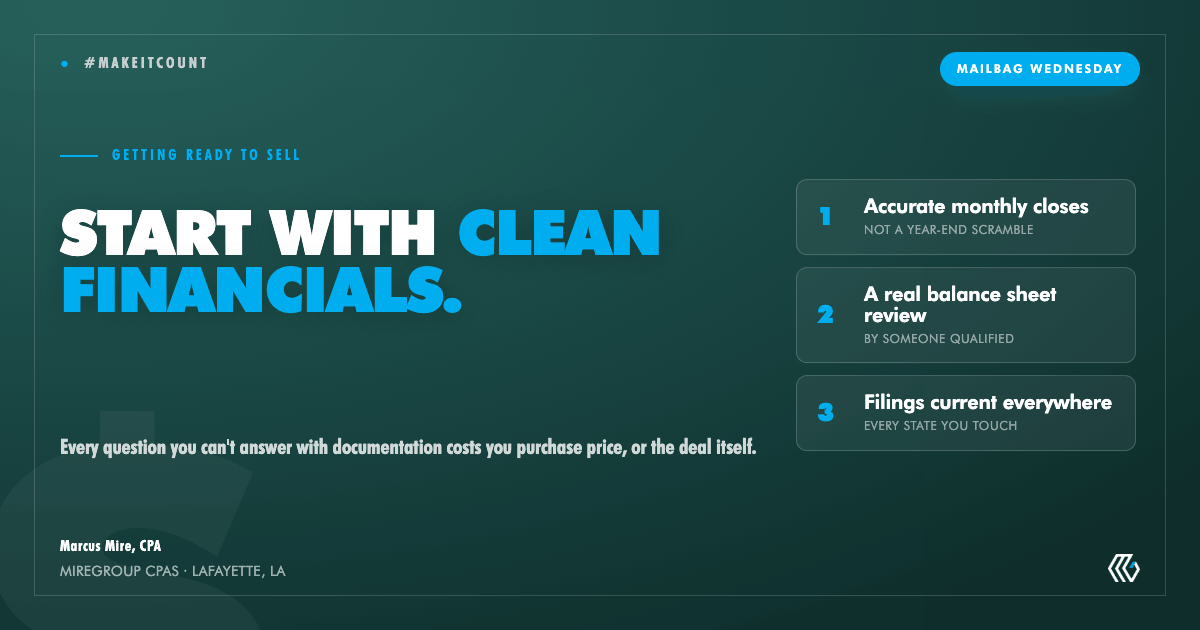
So whether you are three years out from selling, planning to hand this thing to your kids, or you have never once thought about it, the work is the same. Accurate monthly closes. A real balance sheet somebody qualified has actually looked at. Filings current everywhere you have exposure.
Boring, and consistent. That is usually where the money is.
If you want to see what clean books look like in practice, I laid it out here: mire.group/blog/what-clean-bookkeeping-looks-like
And if you want somebody to look at yours and tell you straight, we would love to help. We walk through the whole thing here: mire.group/work-with-us
Make it count,
Marcus

 Mire Group Marketing: Oct 8, 2026, 12:08:35 PM