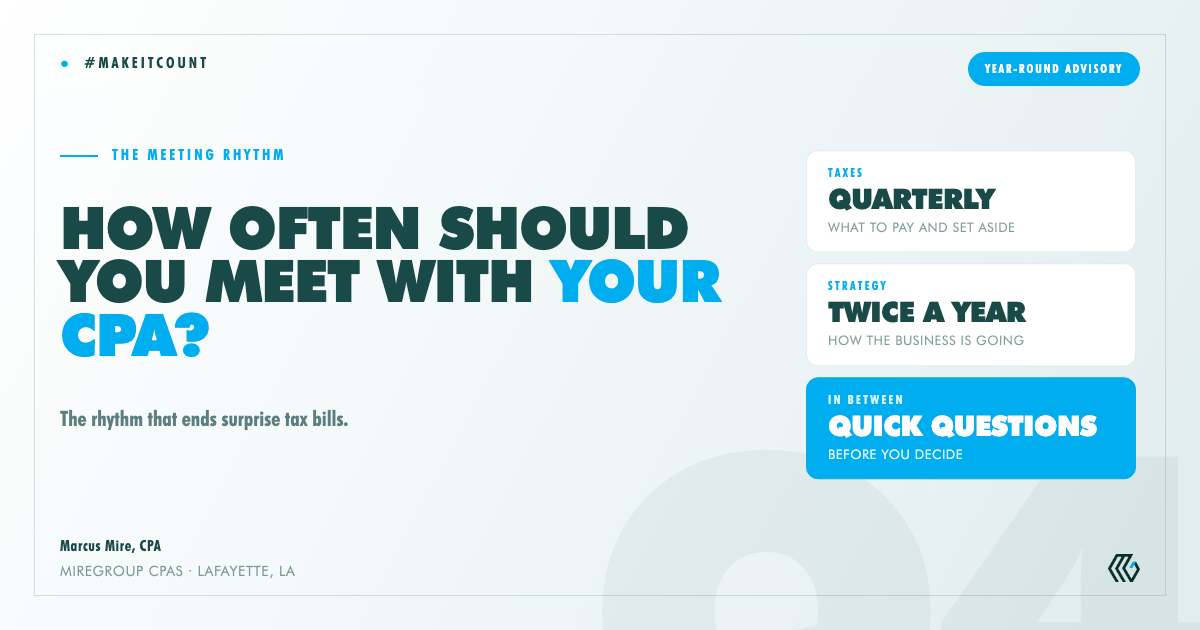
If you own a business, plan on meeting with your CPA at least quarterly for taxes and at least twice a year for strategy, with quick questions in between whenever something comes up. The quarterly meetings tell you what to pay in and what to set aside. The strategy meetings look at how the business is going and what tax planning makes sense. In between, you should be able to call, text, or email before you make a decision.
I'm Marcus Mire, CPA and founder of MireGroup CPAs in Lafayette, Louisiana. I recorded this right around October 15th, the deadline to file your personal return if you filed an extension. That deadline always reminds me why we run our firm the way we do.
What happens when you only see your CPA at tax time?
We still have a handful of clients where we just do a tax return. Probably 20, maybe. Those are the clients we don't work with throughout the year. And a subset of those hand us their documents late in the year. We don't really talk to them.
What happens every time? Surprises.
Believe it or not, when you owe money and it surprises you, it surprises your CPA too. We don't like it either. I don't want to call you and say I had no clue you were going to owe $30,000, and neither did you. That's not fun for either of us.
If you give us your documents in September for a year that's already over, and we had no hand in the planning, the strategy, or the structure, the tax return is what it is. At that point you're hoping we do it accurately and professionally, which you should hope for. But there's really nothing left for us to do. More on that in how to avoid a surprise tax bill.
What does a year-round meeting schedule look like?
Here's what working with somebody throughout the year looks like with us:
- Your bookkeeping, all year. We either do it for you or we review your in-house person timely to make sure the data is good.
- Quarterly tax meetings. We see what you owe and what you need to set aside, give you the payment amounts, and tell you how to pay. You know the money in your bank account is yours.
- Strategy meetings, at least twice a year. How's business going? What were your goals? Where are we? What can we do on tax planning?
- Quick questions, anytime. Phone calls, texts, emails. I'm thinking about a retirement plan. I'm thinking about buying a vehicle. How should I structure this?
If something gets outside that scope, we set up a consulting engagement on top. But for most small businesses, that's all you need. Here's what happens inside one of our advisory meetings.
What's different at filing time when you've met all year?
We're finishing some of our year-round clients' returns right now too. Maybe they were waiting on a K-1 or another tax document. But their return was planned for, strategized, and paid.
We did the planning in October, November, and December. We projected what their taxes would be through the year. We had them paying quarterly. When we file, the return is really just confirmation of what we already planned for.
Sometimes it's off 5 or 10%, because when we're planning we're using estimates. But everybody knows where we were going and what documents we'd need. You just get a better overall outcome.
Do you need advanced strategies to get value from these meetings?
No. You don't need the exotic stuff you see on TikTok. You don't need the schemes promising secret loopholes only the rich know about.
Most people need solid advice throughout the year, timely accounting data they know is right, taxes paid in, and money set aside. They need to know the money in their bank account is actually there. Sleep good at night. That's 99% of you.
If you want a head start before December 31, work through our year-end playbook. It's 13 questions to answer before the year closes.
Frequently asked questions
I just paid a bunch of taxes. Why didn't anybody plan for me?
Usually because nobody was working with you during the year. If your CPA only sees your documents after the year closes, the return is what it is. Planning happens in the meetings before December 31.
Is meeting with my CPA once a year enough?
If you own a business, usually not. A once-a-year meeting tends to happen after the year is over, when there's nothing left to change. The clients we see getting surprised are the ones who hand over documents and say "do my tax return."
When should year-end tax planning meetings happen?
In the fall. We do our year-end planning in October, November, and December, so there's still time to act before the year closes.
Can I call my CPA between meetings?
You should be able to. Quick questions by phone, text, or email are part of how we work with clients. Bigger projects that go beyond that get their own consulting engagement.
If nobody is meeting with you before the year closes, we walk through the whole thing here.


 Mire Group Marketing: Oct 27, 2026, 11:03:29 AM