The S corp question
My post on the “elect at $60,000 or $80,000” rule drew more comments than anything else I put up this month.
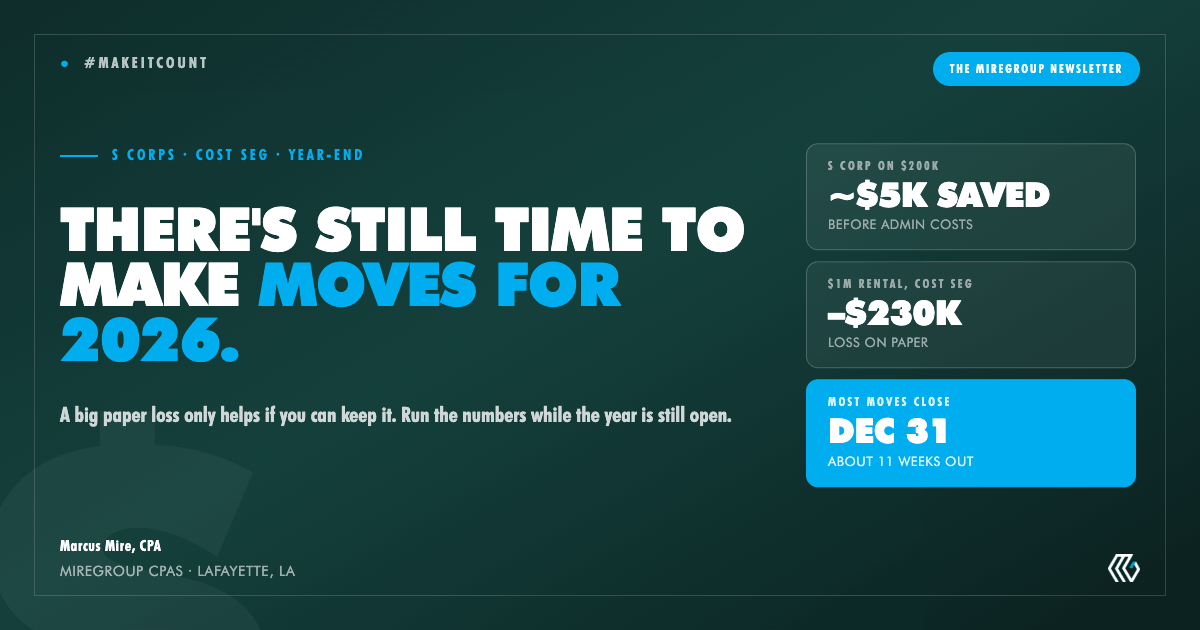
Here’s the short version. On $200,000 of profit, the S corp saved about $5,000 in tax. A separate return, payroll and payroll software can eat $2,000 to $5,000 of that. And the salary shrinks your QBI deduction. In that example, it dropped from about $37,000 to about $16,000.
There’s no profit number that makes the election automatically worth it. Your numbers decide. If you’re thinking about electing for 2027, now is when to run them.
Join the conversation here
Read it here: Does an S Corp Election Actually Save You Money?
How a $1M rental shows a $230K loss on paper
This was our most-watched Short this month.
Say you buy a $1 million condo at the beach. It rents for $60,000 a year. After property taxes, interest, HOA dues and everything else, you net about $20,000.
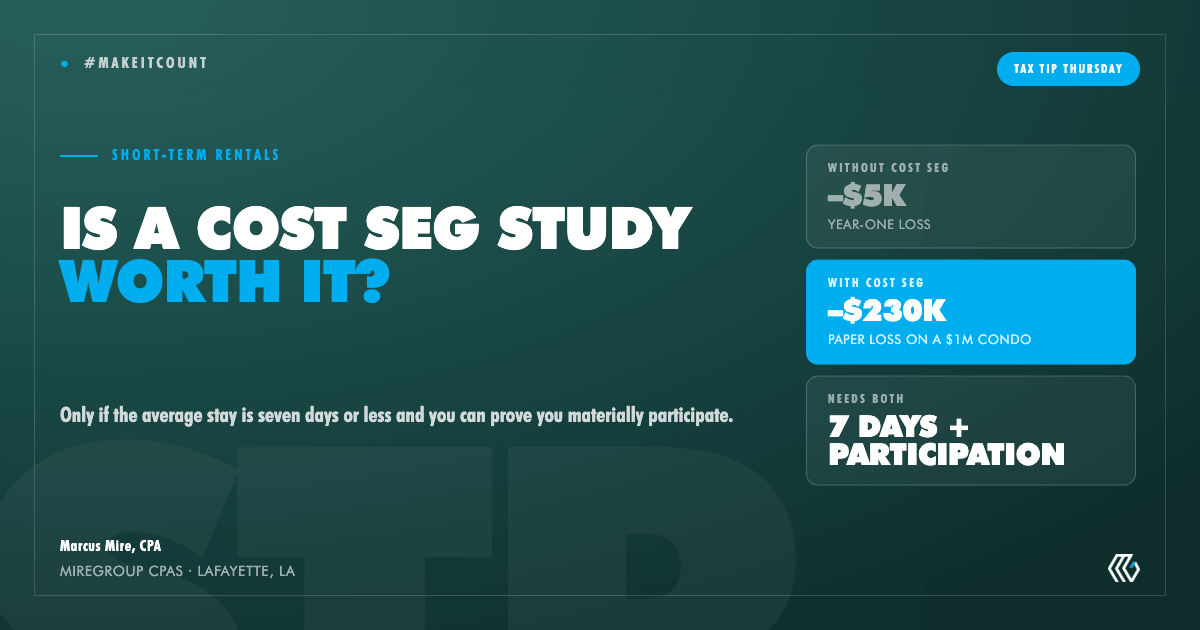
Regular depreciation runs about $25,000 a year. That’s a $5,000 loss.
Now do a cost segregation study. It typically finds 20% to 30% of the property you can write off in year one. Call it 25%. That’s $250,000 of bonus depreciation, and a rental that made money in real life now shows a $230,000 loss on paper.
That’s the short-term rental loophole everybody talks about. Two catches. Your average stay has to be seven days or less, and you have to materially participate. Miss either one and that loss only offsets passive income.
And the one people forget. All that depreciation drops your basis to $750,000. Sell for $900,000, less than you paid, and you still have a $150,000 gain.
Watch it here:
Read it here: Is a Cost Segregation Study Worth It on a Short-Term Rental?
The full real estate guide
The Short runs under a minute. The rules take longer.
If somebody has pitched you real estate as the way to erase your tax bill, read this first. Active versus passive income. What material participation actually takes. Why a property manager can work against you. And why the best real estate CPAs won’t sign off without a time log.
Read it here: Can Real Estate Losses Offset Your W-2 or Business Income?
In case you missed it: the year-end playbook
I sent this at the end of September. Thirteen questions, and nearly every one closes December 31.
We’re about eleven weeks out. Pick the three you can’t answer today. Start there.
Read it here: The Year-End Playbook: 13 Questions to Answer Before December 31
There’s still time to make moves for 2026
Every move in this issue has a date attached. Most of them land before the year closes.
Your S corp salary. Equipment you needed anyway. How you give. What’s headed to your K-1. All of it gets decided while the year is still open, with current books and somebody looking at them.
That’s the whole model here. Fixed monthly fee, year round, so the tax conversation happens while you can still do something about it.
If you want to make your moves before December 31, we’d love to help.
Make it count,
Marcus
P.S. If you take one thing from this issue, take this. A big paper loss only helps if you can keep it. Document as you go, and know what happens when you sell.
#makeitcount


 Mire Group Marketing: Oct 15, 2026, 9:11:20 AM